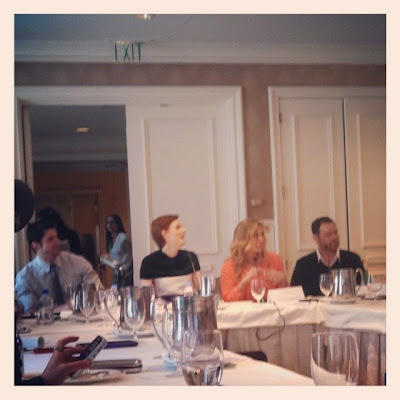
The idea of a killer mirror may sound like the premise of another cheesy low-budget horror movie, but while Mike Flanagan's feature version of his 2006 short Oculus is indeed a lower budget project in the genre, it is certainly not cheesy. From such a dubious-sounding central idea weaves unusually clever and even more unusually smart exercise in terror, one that is intensely cinematic, intimately psychological, and structurally ambitious as it follows two generations of a family grappling with the trail of physical and mental damage apparently caused by a malevolent mirror. Writer-director Flanagan along with stars Karen Gillan (as Kaylie, the adult heroine of the film's present day thread), James Lafferty (as her love interest Michael), Katee Sackhoff, and Rory Cochrane (as Kaylie's parents Marie and Alan, who lead the film's flashback story thread) assembled for a pair of press conferences in Beverly Hills on Wednesday, April 2, to discuss the development of the project and the unique challenges its time-spanning storytelling presented both to those in front of and behind the camera.
The Long of the Short of It
"While we were working on the short, it wasn't about, 'And this could seed a feature!' It was more about, 'How do we really make a really awesome short?' Because we didn't have resources, it was like this was an opportunity to get out there and be like, 'This is what we can do with nothing, but let's make this half-hour short as good as possible.' We didn't have any idea at the time what a feature expansion would look like; it took years to get there. So it was like, if someone comes in and really wants to do it, and it's something that makes sense and feels like it would be an exciting movie that people would want to see, then absolutely. But the priority at the time was not at all beyond just completing that little movie, and hopefully getting it out there to what we knew would be a limited audience because finding a home for short films is really hard. It was like, 'It's going to be a tiny little drop in a pond, but we'd like it to be a cool one.' And that film found a very small audience on the festival circuit that was passionate about it."
--Mike Flanagan
Lessons Learned, Ideas Created
"The short was a fantastic exercise because we didn't have any resources. To create tension and kind of satisfy the genre elements that we wanted to hit without any of the tools you'd expect to have was a great exercise for us. The short didn't have money for lights, so we just had to just wash the whole thing in light. It's really tough if you come into a horror movie, and immediately people try to infuse it with darkness and shadow because we have an inherent fear of that, and it sets a tone for the genre. It's like, 'OK, I'm going to be immersed in darkness and in shadows and in low light and high contrast,' and things like that. So for the short it was like, 'All the lights are on, the room is bright, it's a bright white room, and there's kind of no shadow to hide in, and if we can make that scary, then we can get away with almost anything.' The other thing that it was really useful for was we learned really fast that you could only put a camera in the room with the mirror in one of three places before you'd see it reflected back at you. Shooting in a small space with a large reflective surface is actually a terrible idea, so it was kind of good to work all that out early. So when we got into dealing with the feature, and the question came up very quickly at Intrepid [Pictures, who produced the feature]: how were you going to make this visually interesting if you have to shoot at a reflective surface, how were you not going to see the crew, how were you going to have variation in shots, how were you going to get to move the camera through the space without giving everything away? This is what we learned from doing the short, which was not only dealing with the reflective surface of the mirror, but with these live monitors that were hooked up to cameras that your crew would get caught in too. We've already had to kind of learn the really hard lessons of that. The beauty of the feature was that one room we built on a stage so that we could have wild wall. We could give ourselves just a couple of feet of extra room so that we could keep the camera moving and have a wide variety in our coverage without bumping into the problems of the glass. That was a big lesson that carried over.
"Then the other lesson from the short that I think was the most important was we had wanted it to play like an old campfire story. One of the things about having a sterile, brightly lit environment without any decoration and without anything else was that it forced the viewer to focus on the words and the stories of the mirror that ten minute short was telling. The beauty about a campfire is that you just got the fire; everything else melts away into nothing, so you focus, and you sit and create the story in your own head. The history of the mirror section in the short film made it to the feature almost untouched, and that was something that when you look at it in a script, it's 13 pages of exposition that people will come at and they're saying, ' I don't think this is going to work. It's not going to hold the attention of a viewer to just sit and hear these stories.' And we could point to the short and say it did in the short. It took a lot of really intense coverage and editing in order to keep the pace of just the filmmaking up to keep it interesting, and it takes an actor who can really deliver that kind of intensity again and again and again and again to sell that. That was a really important thing to have because when the feature was getting out there, that scene was one of the more controversial and one of the ones that people would say, 'Well, that's going to get cut way back; people aren't going to sit through that; people aren't going to want to.' So it was really rewarding as we put it together that it turned out to, when we would test the film, show up consistently in the top three favorite scenes of the movie. If we hadn't had the dry run with the short to kind of convince ourselves and other people that an audience can hang on that kind of storytelling for an extended period of time, I don't think we could have ever made an argument to do it in the feature."
--Mike Flanagan
Building Characters...
"One of the things that I loved about the script so much was the time that was devoted to the characters, so we really see them develop before things happen to them, so we're actually invested and care. We really earn the scares, which really excited me, and I just loved the character I played. I thought she was really interesting."
--Karen Gillan
"I think it was the family aspect that really got me, and the fact that there were children involved in the script really tugged at my heartstrings, and then to see the performances that they had given on screen was mindblowing to me."
--James Lafferty
"I just appreciated the family dynamic that could happen sort of without these supernatural forces that were surround this family that... if you took them away, you could still have this family drama."
--Rory Cochrane
"I really loved the fact that we saw in Marie this vulnerability that she had, this obsession that she had with mirrors before the mirror actually took her. And I wanted to really make the audience love this family and understand this family and ultimately feel heartbroken for these children and what they had to go through. Mike [Flanagan] just did a phenomenal job at kind of pulling you on this slow ride that was engaging the entire time and then last 30 minutes just seem to punch you in the face repeatedly."
--Katee Sackhoff
...Destroying Characters (But Not Realism)
"It's a credit to Mike's development of the character, and I think he gave everybody this arc to play with. For me as an actor, I just sort of went against trying to be super creepy and just play the realism of how I felt... in between whatever scene we were doing, what is the reality in this scene--forget the mirrors, forget the ghosts. That's the only way I can wrap my head around it, and that's what I did. You obviously have a slow decline, but I wasn't trying to play that up too much."
--Rory Cochrane
"The children were 13 years old, and I was 32, so to me, I would have had to have the children when I was 18, 19 years old. I wanted to play that as the reality. I didn't want to age myself up or have that played in some negative light, but if that was the reality of the situation, she probably gave up much of her own life for these children, and there's a lot of insecurity that comes from that--like, 'What is your importance to the world beyond being a mother?' I think her insecurities were incredibly obvious from the beginning because I've seen that in so many women, so I understood the insanity of that."
--Katee Sackhoff
But What About the Children? Will Someone Think of the Children?
"Basically [the child actors] filmed their past section of the film first, so that was like the first three weeks of the shoot. So Brenton [Thwaites, who plays the adult version of Kaylie's brother Tim] and I kind of went down to set all the time and just watched what everybody was doing, and absolute credit to Annalise [Basso], who played the younger version of my character, because she absolutely established the character. I went down and watched what she did and just kind of took it from there to kind of extend on it."
--Karen Gillan
"The kids were terrific. They were very resilient and diligent and professional. For me, I didn't have a safe word, but I would check in every take--'Am I hurting you?' And then you'd carve pumpkins on the side, and say 'I'm actually not that bad of a guy.' [laughs] But there were a couple of times when I was choking the girl in particular, and after about the fourth or fifth take, she was like, 'Yeah, maybe ease up a bit on the back of my neck.' Then I felt really bad. [laughs]"
--Rory Cochrane
Navigating That Twisting, Twisted Story Structure
"The braided timeline structure was something that existed in the very first outline for the feature treatment and that we always knew was going to be really difficult to pull off. I'd been working as an editor out here at that point for a little more than a decade. So going into it, it was like, you never know with your movie if it's going to be your last, especially if it's your first. So kind of coming at it and being, 'OK, if everything goes away, and this doesn't work out, how can I make the coolest movie that I'd want to watch if this ends up being my only shot?' So for me it was like, 'How can I set this up in a way that it'll be kind of my own Everest of editing and really kind of lean on all of that sensibility from the script point of view?' The idea was always that we could take these two stories, braid them in a way that the transitions are getting tighter and tighter and we're bouncing back more and more frequently, hopefully to the point that the two stories bleed together in a way that we can't tell the difference any longer, and the characters can't tell the difference any longer. Especially when you're dealing with a monster that's an inanimate object, the way you can sustain tension over a long period of time [was] a big concern coming off the short because I felt that we'd kind of pushed the limit at that point. It was interesting for a half hour; how were we going to triple that? [The way] was to create a sense of distortion and disorientation that would be similar for the viewer as it was for Tim and Kaylie in the room, and that could only really work, I thought, by making the narrative as disorienting as possible--which of course means you're creating a nightmare from a continuity perspective, making it much more difficult for the actors to maintain a continuity within their own performances, but because that clearly was going to be the challenge of it, that was something that we leaned into early. It was like, 'OK, we're going to go with the most difficult road and just really hope that it comes together."
--Mike Flanagan
"We shot out of order, so we're trying to follow this slow decline into everybody unraveling, and one day she looks like a sweet mom, and then the next scene she looks like a vampire or something like that. [laughs] And then she has to go back and forth,and we all kind of did because it was a tight shoot. We just had to stick to the page and trust the people around us and Mike."
--Rory Cochrane
"Mike Flanagan would come up and say, 'OK, so remember at this point, you've had this happen.'--because for the parents, that kind of decline had to be very [gradual]. You didn't want to accidentally shoot a scene that was before, and you're kind of a little too manic, and then your next scene, you're not. So he really would remind you, 'OK, in this scene, this is when you crack. This is when this gets worse.' He had his iPad, and he would bring up dailies from a couple of days before, and be, 'This is what that scene looked like, so this is after that, so don't go too big.' "
--Katee Sackhoff
"The past stuff was written in italics [in the script] and then the present was in a normal font. That it made it so much easier--something so simple."
--Karen Gillan
That Infernal Mirror
"Looking for the mirrors for the short film was challenging mostly because we couldn't afford any. So it was trying to find something that would have character and be gothic but be also beautiful because I didn't want it to be like, 'Who the hell would want to hang this up in their house?' When it came time for the feature, it was like we want to design our own thing, kind of taking some DNA from that original mirror, but trying to come up with something that was going to be even more impactful, more organic, and kind of had more living qualities to it. There's something really awesome that they did with the mirror, which is when you get really close to it, the frame itself is comprised of these writing humanoid forms that are all interlocked. You can't really see it from a few feet away; you have to get right up against it to really pick up that detail. I love that we had crew walking up and like leaning their face up against it to see it. It was only as you really examined it did the horror elements become obvious; I thought that was so cool for the movie. It's hard to show it. There's only one shot, I think, of it in the film, when Karen [Gillan] reaches up and touches it in the auction basement where you can see that design work, but even with that, we didn't want to show it too much. The idea was that this was an organic creature that was kind of digesting the souls of the people that it would come in contact with. We had an idea early on too that we could say the frame had actually been growing subtly over the years as it kept feeding. But looking at it as a living thing was really important to the design. I think the one they came up with is a really interesting riff on some of the elements that the actual mirror in the short had. That [short film] mirror is still hanging in my son's room. Russell Barnes and an artist in Alabama named Bruce Larsen came together and created that frame for [the feature mirror]. I really love that thing--and I really want one of those for my son's room as well."
--Mike Flanagan
"I really didn't have an adverse reaction to the mirror. I really didn't. It looks really cool to me, actually. I sort of want it. is that weird? [laughs] I would have that in my house."
--Karen Gillan
"I just took a mirror off the wall in the rental house I'm in the other day and locked it in the closet. [laughs] I couldn't sleep, and I found a sugar ant in the bed, and that freaked me out. And I'm lying there, and after like 15 minutes, I'm like, 'I feel like such an idiot, but I'm so taking that fucking mirror down!' [laughs] And I took it off the wall, and I hid it in the closet, and then shut the closet door because, God forbid, maybe that would stop the ghost if it got out. A door, like a door, because, you know, that'll work. [laughs]"
--Katee Sackhoff
The Final Word
"One of the coolest facets of what's happened for the feature for me is that it looks like the short will be included in the
DVD when the feature is released. Just the idea of that little movie getting out there to such a big audience is really awesome. While there are always hopes, and you always hope it turns into something bigger, or it at least leads to another project, that wasn't something that we certainly believed would happen while we were making it. And so for everyone who worked on that tiny little movie, it's such a neat thing to be able to call them up and be like, 'Guess what? it's going to be out there in the world! Ten years later, but it'll be out there.' And that for me is one of the really rewarding moments of this entire experience."
--Mike Flanagan
Oculus opens today, Friday, April 11, in cinemas everywhere from Relativity Media.
Buy the Oculus DVD here.
Buy the Oculus Blu-ray here.
Buy the Oculus movie poster here.
Buy the Oculus soundtrack here.
(Special thanks to Mammoth Advertising, Ginsberg Libby, and Relativity Media)