reviewsextraslinksguestbooksitemap
TheMovieReport.com
navigation buttons
Showing posts with label play. Show all posts

Friday, February 18, 2022

F3Stage Review: Slave Play shocks... superficially

Film Flam Flummox

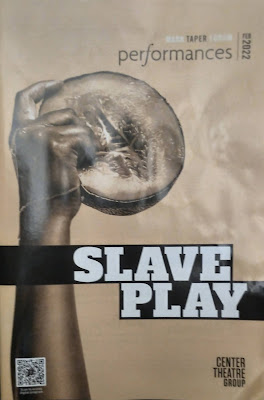
Slave Play program

Jeremy O. Harris's Slave Play has been a lightning rod for controversy and clickbait headlines from its Off-Broadway debut in 2018 through its two Broadway engagements in 2019 and 2021. Now finally debuting in Los Angeles at Mark Taper Forum (following additional controversy when, for a brief spell, Harris pulled the piece from Center Theatre Group's season lineup in a protest against the lack of female-written productions), with the majority of its final New York cast intact, the outrage and intense discussion will surely continue into a fourth year. But after finally sitting through its three-act, intermission-free two hours, one has admiration more for Harris's knack for provocation via self-promotion rather than provoking real thought through the actual substance of his material.

Genuine outrage and offense is, in this observer's opinion, completely justified, but not by the piece's opening act, which has fueled the majority of the clickbait headlines, rather understandably so. A trio of two-hander scenes in period master-slave regalia play out: a Black woman (Antoinette Crowe-Legacy) twerking to Rihanna for her overseer (Paul Alexander Nolan); a mulatto house slave (Jonathan Higginbotham) being pulled into an act of sexual humiliation by his master's wife (Elizabeth Stahlmann); and, in a reversal in two senses, a free Black man (Jakeem Dante Powell) exerts his dominance over a white male indentured servant (Devin Kawaoka). Explicit talk and action ensues as every scenario descends into admittedly uncomfortable psychosexual and racial power plays, but to describe it with words is to make it far more incendiary than how it plays out on stage. The cast, Harris, and director Robert O'Hara pitch the tone so far over the top that one cannot help but wonder in the moment if they're aiming for cartoonish sketch comedy or simply trying way too hard to get a rise from the audience--which, thanks to the mirrored back wall of Clint Ramos's scenic design, can see themselves and their fellow patrons react in real time.

It becomes clear, once the scenes shift with the arrival of act two, that it's a bit of both. Without giving away any of the piece's twists (which, at this point, have been heavily spoiled, but I will not do so here), the tone settles down to a more sober one, but surface silliness makes way for pretentious self-importance, personified on and around the stage by a pair of newly-entered characters played by Chalia La Tour and Irene Sofia Lucio. They, and, in turn, Harris, do make some valid points about the complexities of generational racial trauma and how it subconsciously infects all aspects of life, most specifically sexuality. But any concrete points are beaten to death in this repetitive and interminable act, where conversations and arguments go in so many circles that any valid food for thought, and any cutting satirical points, are flushed down with all of the spiraling.

The tone goes from sober to downright dark in the final act, which is a go-for-broke showcase for Crowe-Legacy and Nolan, who give no less than their all in body and spirit. If only their raw, naked (in every sense) vulnerability were in service of material that deserved it. To be fair, Harris ends this act--and, thus, the entirety of the piece--on a truly upsetting note that more than explains why many an audience member on both coasts has walked out of the theatre in disgust. But after the piece shamelessly, self-consciously, and even gleefully pushes only surface buttons for the bulk of the run time, the weight of the Pandora's Box opened by the closing note feels completely unearned and thus more than a bit insulting, one more salvo of the shallow shock value that characterizes the rest of Slave Play.


The Los Angeles premiere production of Slave Play is now playing at the Mark Taper Forum at the Music Center in Downtown Los Angeles through Sunday, March 13.

(Special thanks to Center Theatre Group)


The Movie Report wants to attend all your live stage productions! Please send any and all invitations to this address. Thanks!

Follow me on Instagram - @twotrey23 Follow me on Twitter - @twotrey23 Subscribe to TheMovieReport.com YouTube Channel

Friday, September 24, 2021

F3Stage Review: The fiery passions & voices of LA Opera's Il Trovatore triumph over a muted design

Film Flam Flummox

Il Trovatore

Giuseppe Verdi's Il Trovatore is a tale of fiery, often conflicting, passions--that of an intense romance; that of an unrequited love; that for revenge--so it makes sense that actual flames notably figure in the physical design of LA Opera's big return to the live stage of the Dorothy Chandler Pavilion. But what really ignites the production is the figurative fireworks set off by voices and performances by the leads, who ultimately shine far brighter than the imposing physical production.

Louis Désiré's design for director Francisco Negín's production is hard to ignore from the initial curtain raise, but not for the extravagant opulence one typically associates with opera; rather, quite the opposite. Ironically, such a tale of emotions run amok--the love and devotion between the troubadour of the title, Manrico (Limmie Pulliam in performances through October 3; Gregory Kunde from October 6 through 10) and Leonora (Guanqun Yu); the Count DiLuna's (Vladimir Stoyanov)'s pathological pining for Leonora; Manrico's mother Azucena's (Raehann Bryce-Davis) quest to avenge her mother's death--plays out in a stark, stone cold grey box with a heavily raked floor. Perhaps reflecting the heavy burdens all the principals carry, there's even a vertical pillar upstage that's occasionally pushed by the leads across the stage length while in song. Undoubtedly, the stark set makes for some occasionally striking stage pictures when working in tandem with other elements (case in point, pictured below, the cross that forms during a scene taking place in a convent) and Bruno Poet's lighting design, and the overall dearth of color makes the pyrotechnic elements all the more punctuating, especially the memorable finale. But with Désiré's costumes similarly muted for the leads and the chorus members, the latter not only additionally done up in anonymous white face makeup, but also literally hiding in the walls much of the time, visually the show becomes a bit monotonous.

Thankfully, though, Verdi's music--and, thus, the emotion of the piece--under the ever-reliable baton of James Conlon is thrilling. Most of the lead quartet is nothing short of exquisite. Yu's Leonora has a luminous soprano to match her graceful stage presence, and her chemistry with the commanding and charismatic Pulliam makes the central romance consistently resonate. Perhaps the real star here is Bryce-Davis, who is simultaneously, appropriately menacing and heartbreaking as Azucena; her ever-simming anger, and the sadness behind it, is mesmerizing as it ultimately consumes all in her path. Stoyanov does not make quite the lasting impression in the less showy role of Count DiLuna, but he is a more than adequate foil to his co-stars. And despites its everlasting ubiquity across all media, the most famous passage of the opera, the "Anvil Chorus," retains its melodic, infectious punch in a live music hall.

And that, right there, underscores how valuable it is to have LA Opera back in season, and even with this Il Trovatore making some unconventional, maybe even questionable, choices, what does work exemplifies how nothing quite matches the creativity and excitement of the live performing arts.


Limmie Pulliam as Manrico, Guanqun Yu as Leonora,
Vladimir Stoyanov as Count di Luna, Morris Robinson as Ferrando
(photo by Cory Weaver)

LA Opera's production of Il Trovatore will have four more performances, on Saturday, September 25; Sunday, October 3; Wednesday, October 6; and Sunday, October 10, at the Dorothy Chandler Pavilion in The Music Center in Downtown Los Angeles. The October 3 and 6 performances will also be available for livestream at the LA Opera On Now digital platform.

(Special thanks to LA Opera)


The Movie Report wants to attend all your live stage productions! Please send any and all invitations to this address. Thanks!

Follow me on Instagram - @twotrey23 Follow me on Twitter - @twotrey23 Subscribe to TheMovieReport.com YouTube Channel

Thursday, September 26, 2019

F3Stage Review: LA Opera stages a darkly alluring & affecting La Bohème

Film Flam Flummox


Giacomo Puccini's La Bohème is one of the most widely known and, thus, widely produced operas around the world, and so it would be easy, and quite understandable, for a company to play it safe and traditional with its staging. But after mounting the same Herbert Ross-directed production no less than seven times (most recently in 2016) over the last 25 years, LA Opera revives Puccini's tale of bohemian bonhomie and tragic romance in a dark, striking, and different staging that director Barrie Kosky premiered in Berlin earlier this year.

The particulars of the plot remain as familiar as they have been to opera aficionados--and, for that matter, fans of Jonathan Larson's ever-popular La Bohème-inspired '90s musical Rent. In 1830s Paris, poet Rodolfo (Saimir Pirgu), "painter" (more on the quotes later) Marcello (Kihun Yoon), philosopher Colline (Nicholas Brownlee), and musician Schaunard (Michael J. Hawk) are starving artist roommates struggling to pay rent to landlord Benoit (who, in Kosky's big deviation, does not appear at all here, with the four instead play-acting his part); Marcello pines over lost love Musetta (Erica Petrocelli), has moved on to another; Rodolfo meets and falls for neighbor Mimi (Marina Costa-Jackson), but looming over their romance is the spectre of disease. Coincidental or not, one cannot help but see some echoes of Larson's work here, from the more youthful than the norm cast, to the Mimi here sharing Mimi Marquez's bright, forceful joie de vivre that only the absolute final stages of terminal illness can dampen, to making Marcello only a metaphoric "painter" and more literally working in film, namely early forms of photography.

But, make no mistake, this La Bohème is distinctly Kosky's own. Much of his concept springs from that shift in Marcello's art, with blacks, whites, and greys dominating the palette he crafts with scenic designer Rufus Didwiszus and lighting director Alessandro Carletti. While this choice falls a bit short in act three, where a static black and white, period photography-tech accurate street scene drop feels a bit too minimalist, it makes for an appropriately ominous atmosphere hanging over the entire proceedings and lends a darkly alluring sense of decadence and indulgence to the act 2 Cafe Momus. It is here that Kosky and his designers appropriately go the most grandiose, with the principal cast and a horde of chorus members young and old in Victoria Behr's striking costumes create a vibrant, bustling, constantly shifting scene on a revolve stage. The exuberance is in effective, sharp relief to more somber turn post-intermission and, of course, in the fourth and final act, where the tragedy is augmented by some truly stunning stage pictures, particularly the final images.

But images would only half serve Puccini's intended effect, and thankfully Kosky's cast is up to the task in lending the characters life. All of the principals are in strong, fine voice, but appropriately the pair of romantic leads make the strongest impression, with Pirgu and Costa-Jackson fittingly striking an immediate spark right from when Rodolfo lights Mimi's candle. Costa-Jackson especially resonates in both literal and character voice, and once Mimi takes her final breath, Kosky's untraditional approach lends the loss and the overall production a lingering and haunting sadness and shiver.


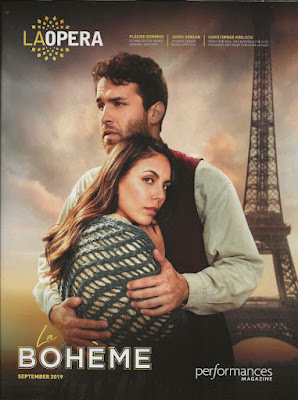
Saimir Pirgu as Rodolfo, Marina Costa-Jackson as Mimi
(photo by Cory Weaver)

LA Opera's production of La Bohème will have two more performances, on Wednesday, October 2, and Sunday, October 6, at the Dorothy Chandler Pavilion in The Music Center in Downtown Los Angeles.

(Special thanks to LA Opera)

The Movie Report wants to attend all your live stage productions! Please send any and all invitations to this address. Thanks!

Follow me on Instagram - @twotrey23 Follow me on Twitter - @twotrey23 Subscribe to TheMovieReport.com YouTube Channel

Monday, September 16, 2019

F3Stage Review: Idina Menzel offers laughs & emotional truth in Skintight

Film Flam Flummox


When one thinks of Idina Menzel, the first thing that most likely, and quite understandably, comes to mind is her spectacular singing voice--to the unfortunate oversight of her no less impressive acting chops. This was never more apparent in her last major stage appearance in If/Then, a production that blessed her with a dual role that was even more dramatically demanding than it was vocally so; while earning her a much deserved third Tony Award nomination, still more attention was paid to the powerhouse pyrotechnics of her pipes than the tear-wringing tour de force of the totality of her turn. Menzel's pure gifts as an actress should never come close to being questioned with her richly wrought work in a change-of-pace straight play role in Joshua Harmon's funny and insightful Skintight, currently playing its west coast premiere engagement at the Geffen Playhouse's Gil Cates Theater in Westwood.

The production's key art being a close-up shot of Menzel's face being done up by the hands of an unseen glam squad is somewhat misleading for a couple of reasons, most notably for this being very much an ensemble piece, with Menzel's Jodi Isaac being one of four equally weighted central characters. Also, however, this is could not be less of a glamorous vanity project for Menzel, whose Jodi, a 40-something divorcée whose ex is about to marry a woman some 20 years their junior, is a raw, riveting mess of neuroses and insecurities. Her sudden presence at the posh and creepily sterile townhouse (scenic designer Lauren Helpern's two-level set is spot-on in its self-consciously clinical chic) of her wealthy fashion designer father Elliot (Harry Groener) for his 70th birthday is met with less than a warm welcome, not so much due to her frazzled state than the inevitable disruption she causes in his seemingly idyllic existence with his much younger live-in love Trey (Will Brittain). Strapping, studly southerner Trey is all of 20 years old, the same age as Jodi's rather effeminate eldest son Benjamin (Eli Gelb), who soon joins the would-be festive gathering from his queer theory studies abroad in Hungary.

That's about all there is as far as plot, but Harmon is less interested in straightforward narrative than exploring issues of aging, maturity, beauty, sexuality, family, and identity via the relationship dynamics within this contrasting quartet of characters. That description sounds heavy, but the proceedings are far from it, with Harmon spiking his genuine and sincere insight with biting, often hilarious, wit. Driving the piece more than the general and relevant themes are his words, which fly fast and furious right from director Daniel Aukin's rather sudden first act lights-up, catching Jodi and Elliot in the midst of what will not be their last heated conversation of the night. The actors are right on pace with the frenetic, full-steam-ahead wordplay, with Menzel's minutes-in, masterful mouthful of a hilarious rant setting a high early bar for the cast and the play as a whole. While the rhythms soon settles down to a less frenetic level, the entire cast's work only grows richer as the banter and barbs recede somewhat and they dive into the deeper dimensions of their characters.

Brittain and Gelb, who originated their roles alongside Menzel earlier this year in Aukin's world premiere Off-Broadway production, especially impress in this respect. They lend roles that both initially strike as contrasting comic stereotypes a complex, harder-to-categorize humanity beyond the more overt surface-level attributes and affectations. Menzel delivers a star turn in the best possible sense, a blazing stage presence whether precision-dropping Harmon's brash bon mots or mining Jodi's deep-seated pain from her tortured history with her father. She instantly wins one's heart over with the many laughs she elicits, and then she proceeds to pierce it with her soulful emotional range. Despite being the newcomer in the cast's core four, Groener, just recently seen on the Los Angeles stage in Indecent, fits right in with the returning trio, forging believable and individually unique rapports with each of his castmates. His is perhaps the hardest role of the piece, not only being the calmer, centering presence amid the more comic counterparts but also generating some empathy and understanding for a character who could be taken as overly cold, shallow, and vain.

And that is right in line with Harmon's overall interest here, inviting and challenging the viewer to find some level of understanding for, though not necessarily agreement with, various viewpoints on the play's key issues as expressed and embodied by the quartet. Much like the characters, with just as much food for thought offered as laughs over the play's two hours, the audience is left to mull over and figure out how one personally handles and navigates such a mental minefield in their own day-to-day, even if it may not be as extreme as seen in the Isaac home. If the psychological and emotional Pandora's Box opened by the convergence and collision of these characters doesn't come close to being tidily tied up by night's end, such is exactly the tightly achieved point of the deceptively loose-in-structure Skintight.


Will Brittain as Trey, Harry Groener as Elliot,
Eli Gelb as Benjamin, Idina Menzel as Jodi in Skintight
(photo by Chris Whitaker)

Skintight is now running at the Gil Cates Theater at the Geffen Playhouse in Westwood through Saturday, October 12.


(Special thanks to Geffen Playhouse)


The Movie Report wants to attend and cover all your live stage productions! Please send any and all invitations to this address. Thanks!

Monday, June 17, 2019

F3Stage Review: The Central Park Five opera powerfully retells the true tragedy of injustice

Film Flam Flummox


Classical-style opera is generally associated with stories and, more often than not, works from many years ago. But the artform can also be used, and rather effectively at that, to tell contemporary stories, particularly those that navigate the often roller coaster gamut of emotion within human existence.  Such is the powerful case (no pun intended) with composer Anthony Davis and librettist Richard Wesley's take on the true tale of tragic injustice that befell the then-so-named The Central Park Five, currently in its world premiere production mounted by the Long Beach Opera.

Three decades may have passed since the five of the title--aged only 14 to 16, four African-American, one Latino--were wrongly convicted of the 1989 beating and rape of a white female jogger in New York's Central Park, but awareness of the story is probably even more widespread today than it was back then, thanks to Ava DuVernay's celebrated miniseries When They See Us, which began streaming on Netflix literally (and completely coincidentally) a couple of weeks ago.  But beyond also being the subject of a near-simultaneously released, higher profile project, this shameful blight in American history could sadly not more  be relevant to and reflective of the social and political climate of today.  Despite a glaring lack of concrete evidence, law enforcement was quick to criminalize young Antron McCray (Derrell Acon), Yusef Salaam (Cedric Berry), Raymond Santana (Orson Van Gay), Kevin Richardson (Bernard Holcomb), and Korey Wise (Nathan Granner), and forced them into false confessions without adult, let alone professional legal, counsel.  A voracious news media was all too quick and eager to go along with the narrative, with prominent figures amplifying the sentiment to even more sensationalistic and alarmist levels, including a certain brash real estate developer (played by Thomas Segen) still many years removed from his eventual perch in the highest political office of the country but already exhibiting and expressing his now-even-more-familiar blowhard attitudes and viewpoints on particular demographic groups.

The one glaring misstep in Wesley's libretto is that depiction of now-45, not in terms of accuracy but in falling into the trap of going for the cheap and easy joke; the second act opens with no less than him on a phone call while sitting on a golden toilet.  But as the term "operatic" is often applied, trafficking in broad strokes to convey a greater truth is a convention in the genre, and having an exaggerated, if cartoonishly so, 45 as well as an amorphous character billed as "The Masque" (Zeffin Quinn Hollis) representing, at various points, either the oppressively long arm of the law, public sentiment, or White Paranoia itself effectively depict the monolithic system that the five and their truth was (and, ultimate, far too belated exoneration aside, still are) up against.  Similarly, with the late exception of Wise, the one of the group who was sent to an adult prison, the five themselves are treated more as a collective than individuals, but so speaks to the larger point of how young men of color, particularly African-Americans, regardless of individual personality and circumstance, are viewed in the same ever-suspicious lens from all angles.

Director Andreas Mitisek's physical production further reinforces this notion in at once spartan and overwhelming fashion.  Doors and screens are often the only objects on stage with the actors, but they more than do their jobs practically and metaphorically, representing the various spaces, rooms, and cells and offering surfaces on which to project many archival video clips, images, and newspaper headlines, smothering the protagonists in their humiliating negativity and prejudice.  Cannily, Davis's score, which pulls as much from jazz influences as it does classical ones, also reflects the persistent tension between black and white, truth and untruth in his copious use of dissonance between the vocal lines and those played by the orchestra.  With the uniformly strong-voiced cast and the gifted musicians in the pit landing all the notes beautifully and memorably, the effect is appropriately jarring and discomfiting in the best way,  That applies to  The Central Park Five  as a whole, an overall beautifully composed and produced work that dares to powerfully remind of an uncomfortable case in recent history and underscore how the circumstances and atmosphere that led to such a tragic injustice are just as much, if not even more, overtly present in the here and now.


The Central Park Five composer Anthony Davis
and director Andreas Mitisek during the pre-show talk
(photo by Michael Dequina)

The Long Beach Opera's world premiere production of Anthony Davis's The Central Park Five will have two more performances, on Saturday, June 22 and Sunday, June 23, at the Warner Grand Theatre in San Pedro.

(Special thanks to Long Beach Opera and Davidson & Choy Publicity)


The Movie Report wants to attend and cover all your live stage productions! Please send any and all invitations to this address. Thanks!
Tuesday, June 11, 2019

F3Stage Review: A far from Indecent history lesson

Film Flam Flummox


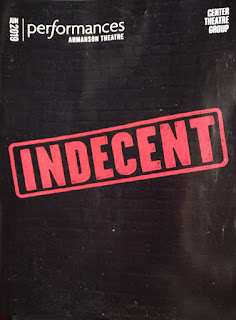
From the moment one enters the Ahmanson Theatre to find its entire cast already seated, silent, on an open and nearly bare stage, director Rebecca Taichman announces the simple yet boundlessly clever stagecraft she brings to Indecent, which, as subtitled on a projection right above the cast, tells "the true story of a little Jewish play." That subtitle succinctly sums up the ostensible subject matter of Paula Vogel's play, but as the piece plays out over its brisk yet loaded two-hour, intermission-free run time, Vogel and Taichman's main concern appears less about that specific story and more about the greater and still-all-too-relevant scope of its thematic concerns.

One is also tempted to say one of those concerns is theatrical technique, for despite its undeniable creativity effectiveness, Taichman's approach keeps one hyper-aware of the theatrical artifice. Six of the seven actors in the cast are officially billed as just that--"Actor"--in the program, for they rotate with remarkable fluidity and versatility through a succession of roles in telling the decades-spanning story of Sholem Asch's landmark Yiddish play God of Vengeance. It begins from it and its author's humble beginnings in 1906 Warsaw and through the global success that leads the work to reach America and finally the Great White Way of Broadway in 1923. It is in the theater capital of the fabled land of the free that, ironically enough, the work runs into its big obstacle in its worldwide journey. A melodrama which earnestly tells of a romance that develops between two young women, including on-stage kiss between the two lovers--which then leads to it being shut down on grounds of indecency and its troupe of actors accordingly arrested. On the base level on the page, Vogel tells this story in as straightforward manner as summarized, with that somewhat by-the-book approach spilling over on stage with copious text supertitles being projected on the back wall (and, in a nice and rare note of mindfulness to those sitting on the sides, also on the left and right walls) serving as lower-thirds chyron equivalents for live theater, labeling characters, locations, time periods, and sometimes even offering supplemental information.

Those identifiers are crucial, not only as Vogel moves through the years but also as the actors impressively shuffle through different roles and even switch languages and accents, at many times on a dime. As mentioned, all but one of the acting septet covers multiple roles, classified by age group and temperament, the sole exception being Richard Topol (one of the four cast members from the original 2017 Broadway production reprising their roles at the Ahmanson) as Lemml, who is not only stage manager for God of Vengeance as it travels the globe over the years, but also serves as a meta one for the very production the audience watches. Thus encapsulates the central conundrum at the heart of this production. While the non-Topol six have a few roles that recur, including that of playwright Asch himself (which is shared by two of the billed Actors, Joby Earle and Harry Groener, at different ages), Vogel's script's briskness covering decades and the many people involved necessitates never delving too deeply into any of the characters, with Lemml and Asch the only having discernible arcs. But if characters then don't forge a strong connection with the audience, it then brings to greater prominence the broad thematic strokes of the piece, which appear to be Vogel's most paramount concern anyhow. While telling of a specific incident in history that centers around a specific community, not only are the general themes such as artistic censorship, immigration, ethnic and LGBTQ prejudice more universally relatable, they are sadly very relevant and timely in this day and age. In fact, given the political atmosphere of contemporary America, the entire scenario could have easily been adapted to current times, and it would ring all too painfully true.

Further making the ideas more resonant is Taichman's ingenious direction. The story theater approach, which frames the events as being presented by Lemml and his troupe from beyond the grave--or, rather, from ashes--may initially strike as a bit precious and on-the-nose, but by the haunting end, it becomes rather chilling. In between though, there's a fair amount of pure enjoyment to go with the heart rending drama, with a mix of period and original music by Lisa Gutkin (who, along with Patrick Ferrell and fellow Broadway production musician Matt Darriau, are on stage the entire time, even intermingling with the cast) making for some memorable dance moments (choreographed by David Dorfman) and serving as a propulsive engine through the numerous changes of scene, with Riccardo Hernandez's spare scenic design lent much versatility by Christopher Akerlind's expressive lighting concept. But most impressive is the cast, which in addition to Topol, Earle, and Groener includes Elizabeth A. Davis (who, in one scene, also plays the viola) and Broadway cast members Adina Verson, Mimi Lieber, and Steven Rattazzi. They all convincingly embody their numerous characters, and watching the six of seven seamlessly, repeatedly transform over the two hours adds additional excitement and even suspense. Indecent may ultimately be an informative if basic primer into the history of God of Vengeance and traditional Yiddish theater and Jewish-American playwrights, but it is executed in such an enthralling and inviting manner that one does feel compelled to investigate further.


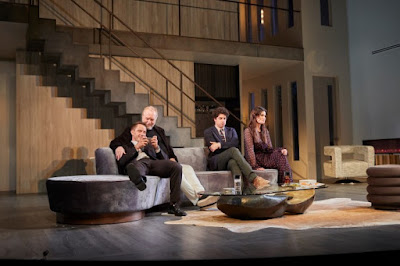
Adina Verson and Elizabeth A. Davis in Indecent
(photo by T. Charles Erickson)

Indecent is now playing at the Ahmanson Theatre in downtown Los Angeles through Sunday, July 7.

Buy the Indecent Original Broadway Cast album CD here.
Buy the Indecent play text by Paula Vogel here.
Watch the Indecent Original Broadway Production here.
Buy The God of Vengeance play text by Sholem Asch here.

(Special thanks to Center Theatre Group)


The Movie Report wants to attend and cover all your live stage productions! Please send any and all invitations to this address. Thanks!

Instagram: @twotrey23

Twitter: @twotrey23