In anticipation of its Los Angeles opening at the Hollywood Pantages Theatre this weekend, the creatives behind Super Freak: The Rick James Story -- star Stokley, writer/producer Je'Caryous Johnson, and executive producer and James's daughter, Ty James -- discussed the stage musical biography of the funk musical legend earlier today.
Super Freak: The Rick James Story opens at the Hollywood Pantages Theatre for four performances only beginning tomorrow, Thursday, June 6, with the production then traveling to various cities throughout the country the remainder of the year.
The Movie Report wants to attend all your live stage productions! Please send any and all invitations to this address. Thanks!
Please help support this site through a generous donation
via Buy a Me a Coffee!
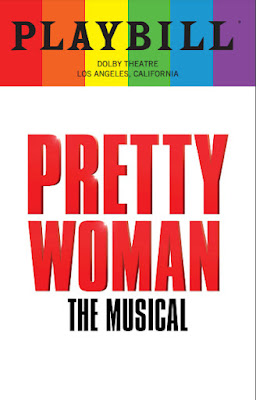
Even if musical adaptations of films were not an increasingly commonplace presence on Broadway in the last fifteen years or so, the beloved 1990 rom-com Pretty Woman would have been a no-brainer for a tuneful treatment. After all, what is Vivian Ward, Hollywood hooker with a heart of gold whose rich client ends up being the knight in shining designer suit of her dreams, but the one and only R-rated Disney (via Touchstone) Princess? Or to take things even further into the legit theater canon, what is this tale of a rough around the edges young woman who undergoes an external makeover and internal awakening with the help of a privileged male benefactor but a variation on Pygmalion / My Fair Lady? With such familiar archetypes and tropes--and, in this day and age, established/beloved IP's--comes a certain luxury that lends theatrical creatives a certain extra latitude for imagination, what with the audience already having built-in comfort from the tried-and-true source material. But then that very advantage can also, even more easily, lead to a certain creative complacency and even laziness--and that sadly is the case with the squandered potential of the perfectly pleasant but ultimately disposable Pretty Woman: The Musical, which only ultimately underscores what rare alchemy the makers of the now-classic film were able to pull off.
Two of those makers, screenwriter J.F. Lawton and the late director Garry Marshall (in what ended up being his final project), are credited with the book here, and at curtain-up they, along with director Jerry Mitchell and songwriters Bryan Adams and Jim Vallance, appear to inject some freshness into what I would presume is an oft-viewed film for most of the audience members. The opening production number "Welcome to Hollywood" effectively sets the scene of 1990 Hollywood, with its big dreams from little people on the fringes (namely, the homeless and prostitutes), while also showing a smart adaptation note in seemingly establishing the film's bookending "Welcome to Hollywood! What's your dream?" drifter (here played by Kyle Taylor Parker) as a narrator of sorts. But perhaps more importantly to fans of the original film, which, while not being a musical, had a very memorable soundtrack, the song and number also capture the buoyant energy with which Go West's otherwise lyrically-inapplicable "King of Wishful Thinking" kickstarted the movie.
The energy soon dissipates when the book scenes immediately begin soon after, with a lost Edward (Adam Pascal) asking an on-the-job Vivian (Olivia Valli) for directions on a Hollywood street corner. All proceeds about exactly as it does on screen, and that's the issue--one that proves to ultimately plague the production as a whole. There is some validity to the old adage of not fixing what isn't broken (and, in this specific case, has held up remarkably well under the three-decade-plus test of time), but Lawton and Marshall don't so much adapt their work for the screen so much as transplant it directly onto the stage, nearly scene for scene, and even more nearly verbatim. As one of those people who has seen the original film countless times, there admittedly is a certain amount of amusement that comes with anticipating certain lines before they are uttered. But that novelty wears off quickly, leaving one with the increasingly nagging question of why exactly (aside from the obvious financial reason) this production exists in the first place.
That elusive raison d'être theoretically should come from the score, which, unlike the book, is wholly original. However, this is one area where the creative team probably could have more effectively used elements from the film. After that rousing opener, Adams and Vallance eventually find themselves in a losing battle against the lingering impression of the classic movie soundtrack. This is not to say their songs are not pleasant to hear, especially sung by voices as strong as Pascal (who, astonishingly, has lost none of his power, edge, and clarity in the quarter century since his star-making turn in Rent's original cast) and Valli's. Given how the songs here are more or less merely grafted onto the existing screenplay, Adams's well-established brand of agreeable pop is at its best here when called on to catch the general vibe of a scene/beat's movie counterpart, as they do with the opening scene and "Rodeo Drive," a pre-first shopping spree number for Vivian's BFF/mentor Kit De Luca (Jessica Crouch) that reasonably duplicates the raucous, rock-y verve of Natalie Cole's "Wild Women Do." While the commitment to serve up completely original songs is admirable, whenever they attempt to replace the iconic sonic touchstones (no pun intended) from the source, Adams and Vallance are at their least inspired. Vivian's second, and far more fruitful, attempt at a shopping spree makes for a smart intermission break point, and while nothing anyone could ever compose could ever compete with the Roy Orbison evergreen that lent the film its title (which does, eventually, get performed, but only as a half-hearted curtain call), it is a plum opportunity for an all-stops-out act one closer in its own right. Alas, what Adams and Vallance offer is neither melodically nor lyrically memorable from the moment the lights black out, ending the first half with a whimper. Even more meek is their replacement for the film's climactic chart topper, Roxette's "It Must Have Been Love"--a ready-made (both in music and lyrics), barnstorming, no-dry-eye-in-the-house 11 o'clock number if there ever was one. Repeating the word "extraordinary" ad nauseum to a sluggish, soppy tune does not quite pack the needed punch for a moment that calls for a power ballad. (One cannot help but wonder why, unlike other stage adaptors of popular films, Lawton, Marshall, and Mitchell did not simply license and retain the source film's most memorable songs, à la Ghost: The Musical; one can only surmise a veteran pop star like Adams would only agree to compose no less than a 100% original score.)
Hamstrung by the limitations of the book and score, Mitchell mostly does whatever else he can to freshen up the proceedings. Also serving as choreographer, he never passes up an opportunity to showcase the dance skills of his gifted ensemble. While some of these passages are a bit gratuitous, such as an extended dance break for the helpful Regent Beverly Wilshire Hotel manager Barnard Thompson (also played by Parker, in a bit of dual casting that initially seems to have, but ultimately doesn't, have an additional meaning) with one of his bellhops, the impressive moves do help to keep the energy level up. Despite generally lackluster, no more than merely functional, scenic design by David Rockwell (for all of its Hollywood-ized, feel-good gloss, the Marshall film was able to clearly paint a contrast between Vivian and Edward's worlds; not so much here, where the minimalist approach, down to a literally blank backdrop, makes both Hollywood Boulevard and Beverly Hills look rather cheap), Mitchell does craft some interesting set pieces, most notably a recreation of the famous opera scene, where a creative blend of dance, excerpts from La Traviata (immaculately sung by Amma Osei), one of the better Adams/Vallance tunes ("You and I"), and a replica of Julia Roberts's famous red dress make for a highlight that honors but does not completely ape the original. Also working on a similar honoring-but-not-duplicating note is Mitchell's casting, particularly that of the leads, who do make a worthy, valiant effort to step out of their film predecessors' shadows and inject their characters and the pairing with their own unique spins. A suitably dashing Pascal has the easier job, what with Richard Gere being the blankest of slates in the film, and being a generally more vibrant actor, he more clearly tracks Edward's thawing and loosening under Vivian's spell. As such, he and Valli create a beguiling chemistry distinct from the fire-and-ice Roberts/Gere match. Valli makes the most of her first major lead, injecting Vivian with a beautiful and versatile singing voice, loads of charm and spunk, and a bit more of an edge to her presence than America's Sweetheart-era Roberts. She truly is a name to watch.
And that's, ironically, kind of a shame since Pretty Woman: The Musical should, in theory, itself be a star-making vehicle for an actress on the stage as it was for Roberts on the screen. But Valli, as naturally shining a presence as she is, can only do so much with a production where--new, generally forgettable songs notwithstanding--slavish adherence to the film is the general modus operandi. She, or anyone else playing Vivian on stage, can switch up the inflections and rhythms of her line deliveries as much as they want, but that those lines and those costumes are the same as those spoken and donned by Roberts serve as a constant reminder of that iconic turn that was immortalized (and then replayed/rewatched ad nauseum) over 30 years ago, and suffocate any chance for its star--and the show as a whole--from standing on its own.
The First National Tour of Pretty Woman: The Musical is now playing at the Dolby Theatre in Hollywood through Sunday, July 3; the production then moves to Orange County at the Segerstrom Center for the Arts in Costa Mesa from Tuesday, July 5 through Sunday, July 17 before continuing to other cities across America through 2023.
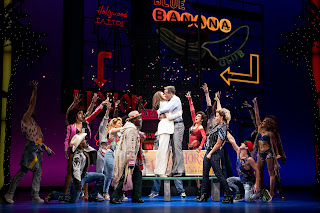
Olivia Valli as Vivian Ward, Adam Pascal as Edward Lewis,
and the company of Pretty Woman: The Musical
(photo by Matthew Murphy for MurphyMade)
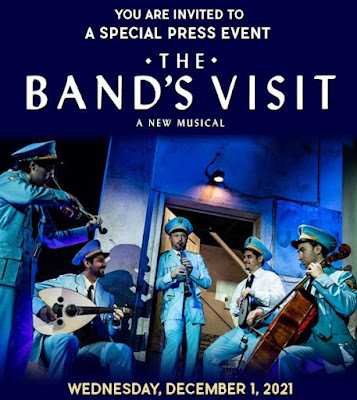
Less than a day after taking the stage for their official opening night at the Dolby Theatre, The Band's Visit First National Cast members Janet Dacal, Sasson Gabay, Joe Joseph, and Coby Getzug discussed the multiple Tony Award-winning musical in a special event held for media this morning, Wednesday, December 1, at the Hollywood Roosevelt Hotel. Joining them for the event taking place diagonally across Hollywood Boulevard from their stage home for the next few weeks were the non-actor members of the titular band, Roger Kashou, Wick Simmons, Yoni Avi Battat, Kane Mathis, and Brian Krock, who treated the assembled audience to two live musical performances while in full costume. Video of the entire panel and performances are below.
The first national tour of The Band's Visit is now playing at the Dolby Theatre in Hollywood through Sunday, December 19; the national tour then moves on to other cities across North America through 2022, including a return to the Southern California area at the Segerstrom Center for the Arts in Costa Mesa from Tuesday, March 22 through Sunday, April 3, 2022.
It seems almost ridiculous to think a beloved old musical chestnut of stage and screen such as My Fair Lady could ever be considered "controversial" or even "divisive," but that actually happened within the community of theater aficionados when Bartlett Sher's revival production opened at Lincoln Center in New York in 2018. While enjoying a successful run of about 15 months, during that time it remained a subject of debate due not to any deletions or alterations to the familiar text and music but... an adjustment in stage direction. While such a subtle move does indeed make an inversely dramatic impact at the final curtain, one thing about this production, whose national tour is now playing in Hollywood at the Dolby Theatre, that cannot be disputed is that it is a fittingly classy staging that more than respects the deservedly enduring original work of Alan Jay Lerner and Frederick Loewe. It's just that Sher's production now also honors the social reality of it being a work from the 1950s being mounted in the 2020s, and in a way that feels completely appropriate with the ideas and issues already addressed by the creators in the first place.
And those issues, as relevant as they are now as they were back then, are that of class and gender roles. The genius, of course, of Lerner and Loewe's adaptation of George Bernard Shaw's straight play Pygmalion is that the weightier concerns are seamlessly packaged in such an appealingly accessible and downright fun package. This is no better exemplified by the delightful performance of stage superstar-to-be Shereen Ahmed as the eventual "fair lady" of the title, young Cockney flower saleswoman Eliza Doolittle. She is a game comedienne as the rough-around-the-edges, Eliza is taken in by snooty professor Henry Higgins (Laird Mackintosh), who sets out to transform her into a refined, well spoken "lady" in a bet with colleague Colonel Pickering (Kevin Pariseau). Not only is she golden in physical gags or barbed, culture clash banter with Mackintosh, she consistently maintains Eliza's harsh accent in the early songs without sacrificing the timeless beauty of Loewe's melodies, for which her glorious soprano was made to sing.
The effortless charm with which Ahmed instantly wins over the viewer is key following the outcome of Higgins's "experiment" and the very real fallout from all the comic shenanigans. While Sher's production remains consistently fun throughout both its acts, it more clearly foregrounds Eliza's conflicting emotions following the show's centerpiece ball scene. Case in point, the celebratory "You Did It" number, in which the spirited singing of Higgins, Pickering, and others is strikingly contrasted with, Eliza's eloquently wordless actions and expressions, which speak just as loudly as the song. More than just a quiet way for setting the stage for what has always been the driving question for the remainder of act two, that of what Eliza's "refinement" and resulting new prospects mean for her future, it also underscores Sher's emphatic, and rather relevant to the current social climate, perspective and power shift to Eliza and Eliza alone. Yes, the effect going forward on the relationship/situationship with her mentor (or, perhaps more accurately, abuser, given the condescension, manipulation, and exploitation that sparked the link in the first place?) Higgins is part of the question, and still a major one at that. But here it's not so much a formulaic, love-hate "will they or won't they?" romantic issue that places them on equal ground rather than one that more plausibly reflects the post-"transformation" reversion of their dynamic. It's now all about Eliza's matured feelings and expanded world view and how/if Higgins can comfortably fit there for her, not about being overly mindful and concerned with his feelings out of blind loyalty--or, to step back and into a general artistic standpoint, out of shameless, easy crowd pleasing and pandering. From this comes that bold adjustment to the stage direction, which, given the modern thematic lens of Sher's creative vision, is completely organic, earned, and, quite frankly, inevitable.
Even more undeniable, though, even from anyone who has any doubts about Sher's more radical touches, is what a lush and often gorgeous production this is. Michael Yeargan's sets, in particular the rather spectacular revolving one for Higgins's house, are visually striking while being practical to keep the action and story going; ditto Catherine Zuber's costumes, with Eliza's ball gown being a particularly "loverly" highlight. Ahmed's voice may rise above all, but everyone else in the ensemble is in vocally fine form (as Eliza's hopelessly besotted suitor Freddy, Sam Simahk is especially impressive) and have great stage rapports with their castmates. Christopher Gattelli's choreography is perhaps one area where the envelope is nudged maybe slightly too far, namely in Eliza's father Alfred's (Adam Grupper) second act showstopper "Get Me to the Church on Time." Gender roles may be pertinent in this piece, but an extended drag bit in this number feels like needless overkill in a production that is largely defined by its finesse.
Such finesse is quite fitting for as sturdy an entertainment as My Fair Lady, which 65 years after its Broadway debut still makes for a wildly enjoyable night at the theater that delivers in music, laughs, and emotion. That, at its very end, Sher also leaves his audience with food for thought is just the proverbial cherry on top.
The Lincoln Center Theater production of My Fair Lady is now playing at the Dolby Theatre in Hollywood through Sunday, October 31; the national tour then moves on to other cities across North America through 2022, including a return to Southern California at the Segerstrom Center for the Arts in Costa Mesa from Tuesday, January 11 through Sunday, January 23.
Giuseppe Verdi's Il Trovatore is a tale of fiery, often conflicting, passions--that of an intense romance; that of an unrequited love; that for revenge--so it makes sense that actual flames notably figure in the physical design of LA Opera's big return to the live stage of the Dorothy Chandler Pavilion. But what really ignites the production is the figurative fireworks set off by voices and performances by the leads, who ultimately shine far brighter than the imposing physical production.
Louis Désiré's design for director Francisco Negín's production is hard to ignore from the initial curtain raise, but not for the extravagant opulence one typically associates with opera; rather, quite the opposite. Ironically, such a tale of emotions run amok--the love and devotion between the troubadour of the title, Manrico (Limmie Pulliam in performances through October 3; Gregory Kunde from October 6 through 10) and Leonora (Guanqun Yu); the Count DiLuna's (Vladimir Stoyanov)'s pathological pining for Leonora; Manrico's mother Azucena's (Raehann Bryce-Davis) quest to avenge her mother's death--plays out in a stark, stone cold grey box with a heavily raked floor. Perhaps reflecting the heavy burdens all the principals carry, there's even a vertical pillar upstage that's occasionally pushed by the leads across the stage length while in song. Undoubtedly, the stark set makes for some occasionally striking stage pictures when working in tandem with other elements (case in point, pictured below, the cross that forms during a scene taking place in a convent) and Bruno Poet's lighting design, and the overall dearth of color makes the pyrotechnic elements all the more punctuating, especially the memorable finale. But with Désiré's costumes similarly muted for the leads and the chorus members, the latter not only additionally done up in anonymous white face makeup, but also literally hiding in the walls much of the time, visually the show becomes a bit monotonous.
Thankfully, though, Verdi's music--and, thus, the emotion of the piece--under the ever-reliable baton of James Conlon is thrilling. Most of the lead quartet is nothing short of exquisite. Yu's Leonora has a luminous soprano to match her graceful stage presence, and her chemistry with the commanding and charismatic Pulliam makes the central romance consistently resonate. Perhaps the real star here is Bryce-Davis, who is simultaneously, appropriately menacing and heartbreaking as Azucena; her ever-simming anger, and the sadness behind it, is mesmerizing as it ultimately consumes all in her path. Stoyanov does not make quite the lasting impression in the less showy role of Count DiLuna, but he is a more than adequate foil to his co-stars. And despites its everlasting ubiquity across all media, the most famous passage of the opera, the "Anvil Chorus," retains its melodic, infectious punch in a live music hall.
And that, right there, underscores how valuable it is to have LA Opera back in season, and even with this Il Trovatore making some unconventional, maybe even questionable, choices, what does work exemplifies how nothing quite matches the creativity and excitement of the live performing arts.
Limmie Pulliam as Manrico, Guanqun Yu as Leonora,
Vladimir Stoyanov as Count di Luna, Morris Robinson as Ferrando
(photo by Cory Weaver)
Tuesday, November 9 to Sunday, December 12
Opening Weekend: November 13 & 14, 2021
PASADENA, CA (September 23, 2021) – Pasadena Playhouse, the State Theater of
California, announces initial casting – Alaska 5000 (RuPaul’s Drag Race), Lea
DeLaria (Orange is the New Black), Yurel Echezarreta (Steven Spielberg’s West
Side Story), Tiffany Mann (Be More Chill), George Salazar (Little Shop of Horrors),
Emily Skeggs (Fun Home), and Shanice Williams (“Dorothy” in NBC’s The Wiz
Live!) – for Head Over Heels, with music of The Go-Go’s, which kicks off the
Playhouse’s 2021-2022 season. The historic Pasadena Playhouse will be fully
transformed for the production creating an experience with both traditional reserved
theater seats and a general admission dance floor. Performances are scheduled from
November 9 through December 12; the press opening weekend is November 13 and
14. Tickets are on sale now, starting at $30, at pasadenaplayhouse.org.
Cast Overview:
Alaska 5000 (Queen Gynecia) is the winner of the second season of RuPaul's
Drag Race All Stars and runner-up on the fifth season of RuPaul's Drag Race.
Lea DeLaria (King Basilius) has had a multi-faceted career as a comedian,
actress, and jazz musician, spanning decades, including her three-time SAG
Award-winning role as “Carrie ‘Big Boo’ Black” in Orange is the New Black.
Yurel Echezarreta (The Player) was in the Broadway production of Head Over
Heels, as well as Moulin Rouge!, Aladdin, Matilda, and La Cage aux Folles, and
Steven Spielberg’s West
Side Story.
Tiffany Mann (Pamela) appeared on Broadway in Be More Chill and is a Lucille
Lortel Award winner for Jerry Springer the Opera.
George Salazar (Musidorus) was last seen as “Seymour Krelborn” at Pasadena Playhouse in Little Shop of Horrors and starred as “Michael” in the Broadway
production of Be More Chill (Lucille Lortel winner and Drama Desk Nominee for
Outstanding Featured Actor in a Musical).
Emily Skeggs (Mopsa) was nominated for both a Tony and Grammy Award for
her work in the Broadway award-winning production of Fun Home.
Shanice Williams (Philoclea) is best known for her portrayal of “Dorothy” on
NBC’s The Wiz Live!
The remaining role of “The Oracle” will round out the cast of eight and will be
announced at a later date.
In addition, Pasadena Playhouse announces the full creative team. The production is
being directed, choreographed, and conceived by Jenny Koons and Sam Pinkleton and
features music direction by Kris Kukul, scenic design by David Meyer; costume design
by Hahnji Jang; lighting design by Stacey Derosier; sound design by Danny Erdberg
and Ursula Kwong Brown; casting by Ryan Tymensky of The Telsey Office, and stage
management by Sara Sahin. Head Over Heels, with songs by The Go-Go’s, is based
on The Arcadia by Sir Philip Sidney, conceived by and features an original book by Jeff
Whitty, and adapted by James Magruder.
About the Show and Design Concept
Head Over Heels is a musical comedy, set to the music of the iconic LA-based female
rock band The Go-Go’s, that follows a royal family in search of a purpose, lovers in
search of each other, and a whole kingdom in search of a beat. Featuring the hit songs
"Our Lips Are Sealed," "Vacation," Belinda Carlisle’s "Heaven is a Place on Earth," and "Mad
About You," among others, the audience will be whisked away through a world of
exuberance and wit from the first notes of "We Got the Beat" to the final celebratory
curtain call.
Head Over Heels has been reimagined for the Playhouse by Director/Choreographer
Jenny Koons and Director/Choreographer Sam Pinkleton in an all new experiential
production. Originally produced for a traditional proscenium stage on Broadway in 2018,
the Playhouse’s 90-minute, intermission-free production puts the audience in the middle
of a non-stop, dance-filled joyride through magic, merriment, and mischief. With the
actors performing all over the converted theater, every seat, or spot on the dance floor,
will have a unique vantage point and an experience to remember. Patrons will be
required to be fully vaccinated and wear masks when entering the theater.
Whether you prefer to watch this play as a traditional theatrical experience or to be in
the middle of all the action, the Playhouse will ensure that you will have a good time.
Danny Feldman, Pasadena Playhouse Producing Artistic Director said, “We return to
the stage with a party for all. There’s been nothing like it in our 100+ year history. Our
historic theater will be turned on its head as the audience joins in on the exuberant
celebration. This is a live musical experience created just for this moment, this theater,
and this community."
Tickets for Head Over Heels start at $30 and are available at pasadenaplayhouse.org,
by phone at 626-356-7529, and at the Box Office at 39 S. El Molino Avenue, Pasadena,
CA 91101.
COVID-19 and Patron Safety Guidelines
Pasadena Playhouse’s HVAC system is in the process of a complete overhaul and
modernization. The new air filtration and ventilation system along with other strict
COVID-19 safety protocols will ensure a safe return to the theater for Head Over Heels.
Pasadena Playhouse will follow all safety protocols put forth by Los Angeles County and
the City of Pasadena. At this time, the following safety plan will be in place upon our
return to stage:
All patrons will be required to wear a mask fully covering their nose and mouth at
all times while in the theater.
Ticket holders will be required to be fully vaccinated and will need to provide a
photo ID and proof of vaccination (physical vaccination card, a picture of
vaccination card, or a digital vaccination record). Guests under 12 will not be
admitted.
Guests who need a reasonable accommodation for medical reasons or due to a
sincerely held religious belief must provide proof of a negative COVID-19 PCR
test taken within 72 hours prior to entering the theater.
The Pasadena Playhouse is a place where people have gathered for 100 years to
experience bold and important theater. It is one of the most prolific theaters in American
history with a legacy of profound theatrical impact and courageous new work. In 1937,
the Playhouse was officially recognized as the State Theater of California for its
contribution and commitment to the dramatic arts. Today it continues that tradition of
excellence under the helm of Producing Artistic Director Danny Feldman. Dedicated to
enriching lives through theater, community programs, and learning initiatives, Pasadena Playhouse is a living force in the community.
The Movie Report wants to attend and cover all your live stage productions! Please send any and all invitations to this address. Thanks!
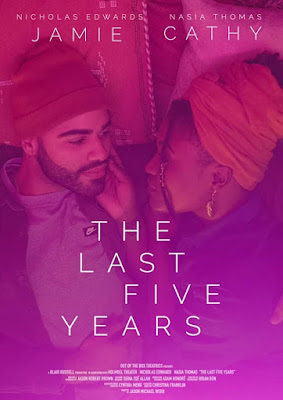
A young woman and a young man take turns telling the touching, tearjerking tale of their five-year romance entirely in song--she, backward from bitter end to hopeful beginning; he, the opposite, with the two meeting in the middle for a single duet--for about 90 minutes. It's a simple tale, and, more often than not in the multitude of productions that Jason Robert Brown's The Last Five Years has enjoyed around the world in the 20 years since its premiere, simply told. But such simplicity can also unlock and galvanize the creative imagination in unexpected ways--as it does in most emotional and exhilarating fashion in Out of the Box Theatrics and Holmdel Theatre Company's truly one of a kind and rather game-changing streaming production.
To simply call The Last 5 Years (as it is stylized in the main and end titles) a virtual theater production, while definitely accurate, feels like a bit of a disservice to the visionary work done here by director (and music director) Jason Michael Webb. For one, unlike many streaming theater productions, the love story of ever-striving actress Cathy Hiatt (Nasia Thomas) and wunderkind writer Jamie Wellerstein (Nicholas Edwards) does not play out on a stage in neither a traditional proscenium auditorium nor a black box studio space. Not for nothing is Out of the Box Theatrics named as such; an Off-Broadway company that stages site-specific productions in non-traditional locations such as playgrounds and libraries, that ethos is taken to another, more brilliant level here. All of the action takes place within the confines of a New York City apartment, and beyond proving to be a scene-appropriate setting for nearly all of the show's individual numbers, it's fitting in terms of subject matter in theme. After all, this the story of a life together (or, rather, a stretch of shared life between two individual ones), and witnessing the drama unfold in their living space(s), with many comfortably lived-in details in the rooms and halls from production designer Adam Honoré only adds to the intimacy. But Webb enthusiastically embraces the uniquely creative artifice that comes with live theater when either settings or situations call for it. Wall projections are occasionally but effectively used, not only to evoke other locations but also as organic enhancements, such as making more readily visible a page of a book. And when saying "all" of the action takes place in the apartment, that's no hyperbole: so does the superb work of the six-person orchestra, who appear on camera individually or in various other groupings at numerous points throughout the show. (This recalls one of my favorite live theater experiences ever: an immersive, "multisensory" production of this same show, mounted by After Hours Theatre Company in Los Angeles in 2019, where the orchestra members moved about the shared performance/audience space along with the actors.) Whether seen sitting on a nearby sofa in an opposite corner of a room, strutting right behind one of the actors in an upbeat number, or blending in with the furniture as another passes through a hallway, what sounds on paper like a possible distraction instead helps to replicate for the home audience the irreplaceable electricity of live performance, and the actors are clearly all the more energized by having live musicians also there in the moment instead of just an audio track.
But if Webb's overall staging and design is unapologetically theatrical, his capture of the production is thrillingly and--to be frank--most atypically cinematic. No one would have been surprised, much less offended, if he stuck with the tried-and-true, generally point-and-shoot "aesthetic" adopted by just about all of the pandemic era's streaming theater offerings, from smaller regional productions to even Disney+'s Hamilton. As entertaining and satisfying as a number of those are, they play more as video documents than full-blooded films. As suggested by the movie one-sheet-styled key art, Webb has taken extra care to make his The Last 5 Years also work, in every aspect, as a new adaptation of the material for the screen. While not as extensively as Richard LaGravanese did in his undervalued 2014 feature film adaptation, in some scenes aside from the midpoint duet, Webb has the pair interact, with the non-singing half being a silent observer or participant. In addition to building and thus making more palpable the rapport between the two lovers, in a more practical sense, this choice helps to break Brown's book out of the static, stagey construction of being mostly a series of alternating monologues. Webb and director of photography Brian Bon don't shy away from having the actors directly address the camera as they would an audience in a more traditional stage production of this piece. Early on, though, Webb ably adapts this convention into cinematic terms, in the third song, Cathy's "See I'm Smiling," where Bon's camera becomes Jamie's subjective perspective in the midst of a heated confrontation. That is just one example of the sterling collaboration between Webb and Bon, which also encompasses a nicely balanced juggling between naturalistic lighting and more overtly theatrical flourishes; the creative visual use of organically found aspects of the real apartment space, such as mirrors and other reflective surfaces, and literally built-in frames such as doorways; to the remarkably fluid camera work as Cathy and Jamie travel through the rooms and through the years. Further adding to that visual finesse is the equally elegant work of video editors W. Alan Waters, Rachel Langley, and Becca Nipper. The icing on the cinematic cake is the terrific sound mix; while designed expressly for at-home digital viewing, one can only imagine how Webb's lush arrangements and orchestrations of Brown's still-glorious score would play through an enveloping cinema sound system.
Of course, visual and sound design would only mean so much without the right actors inhabiting Cathy and Jamie, and Thomas and Edwards are more than just right, they're downright spectacular. It goes without saying that neither are conventional choices for the very Jewish writer and his "Shiksa Goddess." But the pair's incredible work here exemplify the powerful benefit in wide-net, inclusive casting (especially in theater, where literalism is generally a secondary concern), and most especially for oft-performed pieces such as this one--not only in how well they do play the roles and sing the songs as written, but in the fresher, unique dimensions they each bring to the characters with their individual performance styles and strengths. Thomas does not fall into the typically lighter, brighter sound of most Cathys, but literally from scene one, her Cathy hits different, with the wrenching opener "Still Hurting" that much more of a gut-punch when the wails of the climax are delivered with her richer, fuller voice. Richer and fuller also aptly describe her performance as a whole. While still vividly depicting the constant insecurities that cripple her and, ultimately, her relationship with Jamie, Thomas's Cathy is not the meek naïf that the character could easily become in less capable hands. Thomas also lends her a vivacious vitality that appropriately builds as the show progresses forward (and Cathy, in turn, progresses backward) and makes Jamie's electric initial attraction to her all the more convincing. Thomas is at her best in the cheeky ode to a stint in summer stock theater, "A Summer in Ohio," which is still the comic showcase/highlight it has always been, but where most lean into the silliness, she instead unearths a sassy sexiness heretofore not associated with the song.
Edwards has somewhat of an even harder job as Jamie, but he is also more than up to the task. Vocally, that's no surprise, for he more than fits the smooth Broadway-pop template of Jamies past. More daunting is the nature of the role itself. By Brown's own admission, this is a semi-autobiographical piece, and his writing can come off as a somewhat overcompensating apology for his relationship failures, with Jamie teetering on being unlikeable and smug by the end. Edwards in no way sugarcoats Jamie's progression from charming, cocksure confidence to outright, outsize cockiness, but never have I seen an actor convey Jamie's inner recognition of and turmoil over his (d)evolution as Edwards does here. His 11-o'clock-number, "Nobody Needs to Know," has always been one of the show's most emotional, but the rawness of Edwards's performance brings it to the level of epic tragedy, that moment where the hero is forced to face in the mirror (literally) the hubris that not only cements his downfall, but that of everyone he claims to love. (Webb's ingenious staging of this song is also the apex of his theatrical and cinematic instincts melding into a higher plane of artfulness.)
That song and scene stings all the more because of the palpable chemistry between Edwards and Thomas, which, as it should, reaches full, bounteous blossom in the only "official" meeting between Cathy and Jamie in the show, the centerpiece duet "The Next Ten Minutes." Marking the couple's engagement and wedding, the measure of this number's success lies not necessarily in evoking the ecstatic joy that should accompany such a blessed event (which, indeed, Webb, Thomas, and Edwards do), but in the foreboding sense of dread knowing that such bliss will eventually, inevitably collapse before long. When Jamie literally disappears as Cathy sings her closing lines of the song, the perfect note of bittersweetness has been achieved--thus ensuring that this groundbreaking production of The Last 5 Years will linger in audience's minds and hearts for far longer than the next ten minutes.
Nasia Thomas as Cathy, Nicholas Edwards as Jamie
(photo by Gerald Malaval)
The Academy Awards® have a long history of not allowing movie previews and promos to air during its annual telecast, but after what has been arguably the most difficult year for the film and--most of all--the film exhibition industry in modern history, an exception was made in this past Sunday's 93rd ceremony. But, perhaps in a tacit ploy to promote the theatrical experience, or perhaps just owing to Oscars showmanship, or both, the three featured film previews--all for music-driven projects, as it (not so coincentally?) happens--simply did not just air during a regular commercial break, they were more like embedded features of the telecast, being introduced by talent involved with each film.
Clearly the most anticipated look was that of the one film of the three that has remained shrouded in virtual mystery since its production, Steven Spielberg's new take on Leonard Bernstein and Stephen Sondheim's evergreen tale of forbidden love amid warring New York street gangs in the 1950s, West Side Story. To be perfectly frank, while undoubtedly visually striking, and the melancholy rendition of "Somewhere" from the one returning star from the classic and timeless 1961 Robert Wise and Jerome Robbins film adaptation, Rita Moreno, is affecting, there isn't enough for me here just yet to convince me that this take is necessary when the 1961 film has rightly been a cornerstone of the pop culture consciousness in the six decades since its release. Spielberg's film is due out on Friday, December 10, from 20th Century Studios.
After a wildly warm reception at this January's Sundance Film Festival, where it won both the Grand Jury and Audience Awards, the Oscars®' resident DJ this year, Ahmir "Questlove" Thompson's filmmaking debut, Summer of Soul (...or, When the Revolution Could Not Be Televised) had its official launch to the masses with its teaser trailer. A documentary on the 1969 Harlem Cultural Festival, a concert series event that, despite live performances by music legends such as Stevie Wonder, Nina Simone, Gladys Knight, and Sly and the Family Stone, has largely evaporated from the memory. The teaser, which offers a tantalizing glimpse of the never before seen, downright electrifying performance footage featured in the film, indicates that this monumental event will finally have its rightful place cemented in American history when the film is released in cinemas and on Hulu by Searchlight Pictures on Friday, July 2.
Rounding out the trio is Jon M. Chu's screen adaptation of the Tony-winning stage musical that first put superstar composer Lin-Manuel Miranda on the map, In the Heights, finally due out in theatres after a nearly year-long delay on Friday, June 11. Having seen the film more than once already (more thoughts, needless to say, to come, closer to release date), and must commend Warner Bros. for showing unwavering support in pushing this potential blockbuster-in-waiting as an experience that must be shared with a full cinema audience despite the simultaneous, day-and-date drop on HBO Max. The latest in what has been a terrific series of trailers further distills just why this rousing, heartfelt entertainer must be experienced in the largest, loudest, livest way possible.
The Movie Report wants to attend all your press junkets and live stage productions! Please send any and all invitations to this address. Thanks!
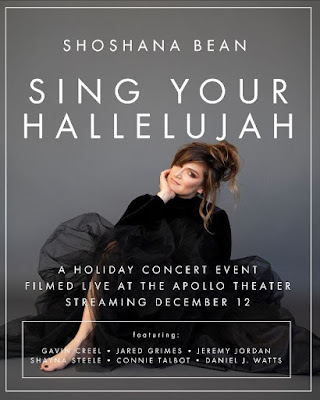
While the entirety of the entertainment industry has been hit hard by the pandemic, no sector has perhaps been more adversely affected than those who primarily work in live theater. But, to adapt the overused adage, the show must somehow go on, and Broadway fan favorite and recording artist Shoshana Bean and a few of her fellow performers return to the stage--no less than that at the legendary Apollo Theater in Harlem--to deliver some much-needed end-of-2020 cheer to audiences around the globe by doing what they do best in the joyous holiday season concert Sing Your Hallelujah.
In many ways, Sing Your Hallelujah is a throwback to one of those music star-centered Christmas season specials that would pop up on network television with greater frequency in years past, and that's definitely a compliment. It goes without saying that Bean's powerhouse pipes are up to the daunting task of filling every corner of a cavernous, virtually empty Apollo with whatever is on the musical docket, from rafter-raisers such as "O Holy Night" to more intimate tunes like "Mary Did You Know" and the original title song. Also as in those yuletides of yesteryear, the headliner is joined on a few numbers by other singers: fellow Broadway veterans Gavin Creel, Shayna Steele, and Bean's former Waitress co-star Jeremy Jordan; and Britain's Got Talent alumna Connie Talbot. In a welcome move to honor the variety of different talents that grace stages in New York and elsewhere, there are a pair of non-singing guests, Jared Grimes, tap dancer extraordinaire; and actor Daniel J. Watts, who performs a spoken word piece. But regardless of how special the guest, and how much each does, indeed, shine, perhaps even more than her spectacular voice, Bean's welcoming warmth holds together and drives these 85 minutes.
Director Amy Segal does not fill all of that run time with performance, including a fair amount of behind-the-scenes footage of Bean and her creative team planning and assembling the show. While that may be a common indulgence in specials such as this, what is hardly common is the unique period in time in which everyone has been living since March. Thus, Sing Your Hallelujah is lent an added weight and dimension as a document of this most precarious moment in all live performers' lives, particularly as the current state limbo has no clear end in immediate sight. If this runs counter to the more intentionally timeless feel of the on-stage concert footage, it provides a valuable insight into not only Bean's personal attitude and story during the pandemic, but into the general quandaries of any performer right now: not just the practical question of how, but also the most existential one of should, one go forward and give something back to the world right now by doing what they know and love the best.
Obviously, Bean decided to go forward, and in so doing she and Segal have not only made a film that achieves its obvious goals of celebrating all live performing artists and creating and spreading joy and love at the end of a most tumultuous year, but also a much deserved celebration of those far too unsung behind-the-scenes artisans and technicians without whom all the productions and experiences we enjoy and cherish would have never been possible. Perhaps even more than Bean and the wealth of talent that takes the stage, that is for whom you will want to sing your hallelujah by the end of this beautiful, beautifully mounted show.