While certainly owing a considerable debt to the time-proven power of
Victor Hugo's original literary classic, the overwhelming emotional sweep of
La Jolla Playhouse's North American premiere production of
The Hunchback of Notre Dame is a remarkable testament to the extraordinary talent of this specific company. From composer Alan Menken and lyricist
Stephen Schwartz, who expand their criminally
undervalued scores for both the
1996 Disney animated feature and
James Lapine's shamefully buried 1999-2002 Berlin world premiere stage adaptation Der Glöckner von Notre Dame; to new librettist
Peter Parnell and new director
Scott Schwartz; to a remarkably gifted ensemble of actors, singers, and musicians, they have accomplished the daunting task of making Hugo's oft-told tale astonish and devastate as if it were brand new.
And, in many senses, this Hunchback is indeed essentially brand new, and rather startlingly so, while still recognizably inspired and derived from Disney's previous incarnations of the material. What will most strongly strike most is the appropriately, almost relentlessly downbeat and often sinister tone Parnell and director Schwartz (as the latter will henceforth be identified, so as not to be confused with the lyricist) have taken here, ironically more than several steps darker than Lapine's take, whose own (in)famously Gothic darkness was a chief reason why Disney had kept it away from the stateside stage for so long. In fact, the official credits in the show program downplay the animated feature, stating the production is "based on the Victor Hugo novel" and merely "with" songs from the Disney film--which comes immediately apparent with the opening number. While "The Bells of Notre Dame" retains Menken's familiar tune, the lush choral arrangements, and the ambitious recitative structure from the film, Parnell and lyricist Schwartz have drastically rewritten it largely as a backstory vehicle for the character of Claude Frollo (Patrick Page), who in keeping with the implicit mission statement of that official credit, is back to being the archdeacon of the Notre Dame cathedral. Thus the issue of faith, or, rather, the conflict and contradictions between the compassion inherent in one's pious duty and more personal, self-serving interests and impulses are further foregrounded here, showing how Frollo's hatred of the gypsies stems from the close relationship with his brother Jehan--and how it was destroyed when he took up with a gypsy woman and ultimately died as a result from his association with the community. Also resulting from this association is one lingering, lasting reminder that serves as an everyday test for Frollo's faith, or more accurately, his idea of faith: Jehan's horribly disfigured son Quasimodo (Michael Arden), whom he raises to serve as the bell ringer of Notre Dame, secluded from the outside world--or, in Frollo's mind, protected from the fate that befell Jehan.
Frollo's obsessively overprotective but undeniably earnest concern for Quasimodo is not only illustrative of how far removed this stage Hunchback is from the Disney film (where, for my money, the character was far and away the most despicable and memorable villain of the '90s Disney Renaissance animation period), but the difficult and complex grey shades that Parnell and director Schwartz take pains in painting. The arcs of the central characters appear fairly straightforward, all stemmed by the alluring gypsy Esmeralda's (Ciara Renée) arrival in Paris: Frollo's faith and code are further tested when she unwittingly incites in him impulses and desires that are far less than godly; more pure are the romantic feelings she stirs in Quasimodo, whose yearnings for a taste of life outside of Notre Dame's walls are made very real by the kindness she shows toward him; the arrogant captain of the cathedral guard Phoebus (Andrew Samonsky) has his self-absorption warm to selflessness when he falls for the proverbial girl from the wrong side of the tracks. But as distinct and divergent as those arcs are on the surface, they all share a strong thematic parallel: that of fiercely held individual beliefs and perceptions challenged, if not outright upended, by the harsh light of reality. While his role is beefed up from the film and now carries the bulk of the piece's comic levity, Phoebus's role is still of a secondary prominence, and not surprisingly how his originally egocentric world view is awakened to a consciousness and concern beyond himself is the most obviously and superficially handled. However, that is compensated by how deeply and powerfully the theme is explored elsewhere, particularly with the focal duo of Frollo and Quasimodo. Casting Frollo back as a member of the clergy makes for a more strikingly nuanced and therefore more realistically uncomfortable and disturbing battle between his stridently self-righteous religious convictions and his baser impulses and desires. This Frollo is no cartoon villain in any sense but a painfully flawed and misguided man who is suddenly confused, overwhelmed, and ultimately consumed by his long-repressed human instincts. As his veneer of control and decorum gradually, inevitably cracks and collapses into obsession and madness, he is not only a reprehensible figure but an equally tragic one as well.
Tragic in a different and more heartbreaking sense is Quasimodo's granted wish to experience life "out there," and with the worldly wisdom of its wonders--namely, that of love--also comes a crash course in the more complex and crueler reality of its people, who, while capable of compassion and acceptance, far from meet his long held idealized vision of them. But a most unexpected and astonishingly powerful angle on the idea comes with Esmeralda, whom Parnell and director Schwartz further deepen from the already well-rounded characterization in the animated feature and Lapine's 1999 adaptation. As in those incarnations, here Esmeralda is as smart and kind as she is feisty and sexy. But in those works, while much is said about the carefree, hedonistic gypsy lifestyle (particularly by Frollo), aside from her introductory dance performance, she's never seen indulging in such behavior, making her to a degree a woman with a heart of gold who, to paraphrase a famous quote from another famous Disney film, isn't bad, but just drawn that way. In Parnell and director Schwartz's hands, Esmeralda's upstanding code of virtue is very much intact, but she certainly isn't above shamelessly carousing and simply enjoying her life--a life built on faith, but that in the belief of an inherent, core goodness of people. As darkness consumes Frollo and circumstances for herself and her people become increasingly dire, even the most self-confident and hopeful of spirits have their breaking points, at which time there is no one and nowhere left to turn to but a different, heretofore eschewed, type of faith.
This surprising arc meets its culmination in a moment that perfectly encapsulates how Parnell and director Schwartz boldly take risks and fearlessly flout what would appear to be conventional thinking in making the material and this production their own. One of the unquestionable highlights of the Lapine production was Esmeralda's climactic 11-o'-clock ballad "Someday" (originally written as a number within the 1996 film but ultimately relegated to serve as the obligatory closing credits pop single), and how could it not be. Perfectly timed within the context of the story with appropriately elaborate staging, poignantly poetic words by lyricist Schwartz, and an epic new choral arrangement by Menken, Esmeralda leads a defiant, soul-stirring anthem of hope that only crescendoes as she literally walks toward certain doom, making for one of those singularly exhilarating and cathartic moments that can only be achieved in live theater. I was expecting and quite looking forward to experiencing such a moment in a proper English language production only to find that Parnell, Menken, and both Schwartzes have turned the song and moment completely on their ear, achieving a feeling even more raw and astonishing. With only minimal revision by lyricist Schwartz and a freshly stripped down arrangement from Menken, "Someday" takes place in the same location and at the exact same story beat, but what was once the rousing musical affirmation of Esmeralda's stalwart resolve now marks the despairing culmination of its destruction. If the famous film holdover "God Help the Outcasts" (incidentally, the tune "Someday" was originally written to possibly replace in the '96 film) marks her first, earnest, but tentative and still not completely convinced ("I don't know if You can hear me/Or if You're even there") steps toward belief in a higher power, then "Someday," sung with Phoebus after she suffers one especially cruel and dehumanizing indignity (new to this incarnation) at Frollo's hands, musically completes Esmeralda's discovery and embrace of God--but in a strikingly starker context than had ever been depicted before. Instead of being a prayer of increasingly joyous affirmation, it is now one born out of last resort desperation and defeat, making for a song and scene that is at once incredibly devastating yet incredibly beautiful.
That description applies to the whole of director Schwartz's production and his novel directorial concept. The prevailing Disney live theater "house style," if you will, has long been one of two equally weighted minds: (1) to hew as closely as possible to the source film, while at the same time (2) piling on the razzle dazzle showmanship that one equates with the Mouse House. Ironically, though, their far and away most all-around successful adaptation, Julie Taymor's handcraft-heavy take on The Lion King, is also one of their more avant garde, and director Schwartz's vision leans far more toward that more abstract--and more overtly theatrical--mind than Lapine's Berlin treatment, whose elaborate set of moving cubes and extensive use of image projections was indeed imaginative (and, in terms of the latter touch, revolutionary for the turn of the millennium era) but certainly as a means to an elaborately spectacular end. As a reflection of the 15th century era in which Hugo's story is set, director Schwartz frames the story kind of like a passion play, with a do-it-yourself "let's put on a show" framework where the seams of a performance proudly and creatively show. If Parnell's addition of a lot of Hugo-derived spoken narration delivered by ensemble and principal player alike (one of the less effective new wrinkles to the text, the role of king of the gypsies Clopin, who served as narrator in both the film and Berlin, has been significantly diminished, a shame given the game performance given in the role here by Erik Liberman) is sometimes guilty of being overly expository and hand-holding the audience where none is needed, the creators otherwise put a lot of trust in the audience to fill in the blanks. While scenic designer Alexander Dodge's primary set, consisting of wooden scaffolding, a beautiful central rose window, and an array of gargantuan bells that descend from the rafters, effectively evokes the grandeur of the cathedral's interior, the rest of the piece's settings are depicted in a more impressionistic manner, with various prop pieces such as benches and railings--and, in some inspired instances, even ensemble players--reconfiguring to form locations such as balconies and rooftops. Perhaps even more bold is the decision to avoid overly elaborate makeup and costuming, notably for Quasimodo and his gargoyle "companions." The latter are effectively reconceived as an abstractly depicted figment of Quasi's imagination, portrayed not as clearly defined characters as in previous Disney incarnations but played by various neutrally-costumed ensemble members as an anonymous but inescapable presence. Perhaps most controversially, though, is the lack of Phantom of the Opera-esque makeup and prosthetics for the lead, with Quasi's physical deformity depicted by a couple of black streaks on Arden's face.
This is why I feel the most emblematic moment in the entire piece occurs right at the close of "The Bells of Notre Dame." On the lyric "What makes a monster/And what makes a man?," Arden sings the line while walking on stage out of character and in upright posture, only to then transform into Quasimodo before the audience's very eyes, with a hump strapped onto his back as he applies the aforementioned makeup streaks on his face and affects a hunched-over gait. Such a risky decision reflects director Schwartz's overriding faith in his actors, and with such a spectacularly talented cast, that faith proves to be well-founded, and also drives home the main point that for all the mystique of its Gothic setting and its organic potential to be played on stage in the most ostentatiously over the top manner possible, the enduring appeal of Hugo's tale lies in the hearts and souls of its characters. Accordingly, the decidedly theatrical and remarkably intimate conceit of this production brings to the fore the epic emotions that drive the characters and stories, and the phenomenal central trio clearly pour their hearts and souls into bringing those interior passions and motivations out into the theatre in overwhelming fashion. The Quasi-Esme-Frollo triumvirate all depends on navigating three distinct but equally fine lines, and Arden, Renée, and Page walk their respective tightropes with deceptive ease. Arden is a soulful, consistently heartbreaking presence, and he makes seamless Quasimodo's transitions from the shy, almost stunted, demeanor he exhibits in the presence of others to the more assertive and articulate inner voice that manifests in song, and the increasingly conflicted and confused emotions that emerge with his gradual enlightenment about the outside world are piercingly poignant. Renée's portrayal lends Esmeralda nuances that run far deeper than the madonna-whore archetype the role could have easily fallen into in both text and performance, painting a believably multi-dimensional, ahead-of-her-time woman aware of and confident in the power of her feminine wiles while remaining steadfast and unyielding in her compassion and moral character. If there is a breakout performance in a production brimming with standout work, it's that of Page. While every bit as forceful and intimidating as Tony Jay's iconic voice performance in the animated feature, his work is perhaps even more frightening because of how relatable and tragically human he makes Frollo's descent into madness. Not for nothing has director Schwartz done away with any embellishment beyond a simple blood red light to the cinema--and now stage--showstopping number "Hellfire": all of the drama of Frollo being devoured by his darker, deranged desires is more than conveyed in Page's powerfully expressive face and, above all, voice.
And that points up what is ultimately the real star of The Hunchback of Notre Dame: that incredible score by Menken and lyricist Schwartz, which is made even more transcendent by the production's pièce de résistance: the onstage presence of the SACRA / PROFANA choir, making for a majestic wall of sound that matches and further amplifies the euphoric highs and devastating lows of the outsize operatic beats, both literal and emotional, of the entire piece. While it has long been my favorite of Menken's Disney film scores, the live theatrical space and performance should finally drag it from under the long, formidable shadow of his and Stephen Schwartz's more popular and celebrated works and earn its overdue recognition as a crowning achievement of both of their illustrious and legendary careers. It is a truly virtuoso piece of period- and genre-blending and -smashing musical artistry that deserves to enjoy as enduring a legacy as Hugo's original novel--or, at the very least, a long, healthy run on Broadway and on legit stages the world over in the years and decades to come.
The Hunchback of Notre Dame is now playing at the La Jolla Playhouse in San Diego through Sunday, December 14. The production then moves next spring to Paper Mill Playhouse in Millburn, New Jersey, where it is scheduled to run from March 4 to April 5, 2015.
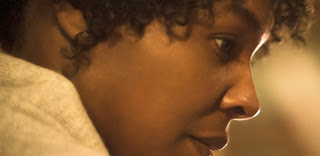
 Michael Arden as Quasimodo
(photo by Kevin Berne)
The Movie Report wants to attend and cover all your live stage productions! Please send any and all invitations to this address. Thanks!