reviewsextraslinksguestbooksitemap
TheMovieReport.com
navigation buttons
Showing posts with label Alan Menken. Show all posts

Monday, May 16, 2022

F3Stage Review: 3-D Theatricals belatedly bounds back to the stage with a noteworthy Newsies

Film Flam Flummox

The Great White Way is littered with many a corpse of would-be blockbuster stage musicals based on beloved films, and--contrary to the most generally held perception--a number of them have been courtesy of the entertainment and cultural behemoth that is Disney.  High profile disappointments such as The Little Mermaid, Tarzan, and Frozen have become more common in the more recent of the Mouse's near-30 years in the legit theater business, but one surprising exception has, ironically, been the stage adaptation of one of the studio's most infamous film flops: the live action musical anomaly that was 1992's Newsies.  Ten years after the property made its unexpectedly triumphant Broadway debut, 3-D Theatricals makes its big return to the Cerritos Center for the Performing Arts in two years with a production that shows just why a largely forgotten screen also-ran has become a modern stage favorite.

For the unitiated, the musical, with book by Harvey Fierstein, music by Alan Menken, and lyrics by Jack Feldman, shares the same obscure historical basis as Kenny Ortega's original film: in 1899 New York City, a group of poor, young street newspaper salesboys--the "newsies" of the title--went on strike in protest of a price increase that would substantially cut their already slim profits.  What came off as stodgy and stilted on screen (due in large part to some self-consciously tentative performances, chiefly that of a young Christian Bale, whose charisma could not mask his lack of comfort in dancing and, especially, singing) proved to be anything but on stage, as seen in the filmed performance featuring much of the principal original Broadway cast that was released in select cinemas (and is now streaming on Disney+)--and, now the 3-D Theatricals production.  While not a replica of Jeff Calhoun's Broadway and national touring production, director T.J. Dawson captures the essence of what gained the piece a fan base that far dwarfs that of the film's cult.  The scenic design by Bruce Brockman (originally done for Music Theatre Wichita) is not on the scale of the massive, moving staircase, scaffolding, and square scrim trio of towers that dominated the original production.  But in form and function, a set of two smaller staircases and a lower, center scaffolding piece plus fly-in screens for the projections, work just as effectively in evoking various New York cityscapes and locations as they are pushed into various configurations by the cast.

It's that last ingredient, the cast, where any production of this piece sinks or swims--particularly in one such as this, which maintains the original Broadway and tour mounting's emphasis on elaborate, athletic, and downright acrobatic choreography.  Dawson goes an extra, uncompromising step in enlisting Chazz Wolcott, a veteran of the First National Tour cast, to recreate Christopher Gattelli's Tony-winning work, so true triple threat talents were required across the board, and the entire company delivers.  More than most shows, the ensemble players deserve special mention, with the many large group numbers supplying and maintaining the bulk of the piece's propulsive energy.  But the principals, particularly Dillon Klena (as newsie leader Jack Kelly) and Allison Sheppard (as, in a bit of a composite of two characters in the source film, young newspaper reporter Katherine, who develops a personal interest in Jack beyond the cause) fluidly, seamlessly slide into the troupe whenever called on to do so.  Sheppard in particular is impressive in the act two opener, "King of New York"; the original film counterpart featured a very brief moment of tap dance, which, in a rather inspired bit of translation to the stage, now dominates and drives the number.

The company of the 3-D Theatricals production of
Newsies, directed by T.J. Dawson and now playing
at Cerritos Center for the Performing Arts.
(photo by CaughtInTheMoment.com)

Driving the entire show's word of mouth since its world premiere at the Paper Mill Playhouse in New Jersey in 2011 has been the spirited dancing, but that alone does not mean a thing if there is no audience connection with the story and characters.  With the former still being the somewhat dry even with all the welcome narrative streamlining and retooling done by Fierstein's book, the actors are called on to add the necessary flavor and engagement, and the lead cast are up to the task. Klena is an effortlessly likable and charismatic presence, and he has excellent chemistry with the luminous Sheppard and his focal fellow newsies, Davey (Rod Bagheri), his younger brother Les (Colton Dorfman), and the aptly nicknamed Crutchie (Kyle Frattini). They are also very able vocalists, revealing just how much Menken's tunes were shortchanged by the film's less capable voices. The designated "adults" in the piece, Norman Large as greedy publisher Joseph Pulitzer and Carrie Compere as vaudeville performer/newsie supporter Medda Larkin, remain fairly thankless, functional roles, they make positive impressions.

Making a lasting impression is 3-D Theatricals' Newsies as a whole, achieving an alchemy where the live experience is exponentially more entertaining and memorable than it would appear on paper. After two years away from the stage, the company's joy in performing again is palpable, and that exuberant energy is infectious and irresistible from first moment to the curtain call.


The 3-D Theatricals production of Newsies is now playing at Cerritos Center for the Performing Arts through Sunday, May 29.

The company of the 3-D Theatricals production of
Newsies, directed by T.J. Dawson and now playing
at Cerritos Center for the Performing Arts.
(photo by CaughtInTheMoment.com)

(Special thanks to 3-D Theatricals and Demand PR)


The Movie Report wants to attend all your live stage productions! Please send any and all invitations to this address. Thanks!

Follow me on Instagram - @twotrey23 Follow me on Twitter - @twotrey23 Subscribe to TheMovieReport.com YouTube Channel

Monday, October 16, 2017

F3Stage Review: Long Beach Landmark Theatre Company rings Disney's Hunchback's bells

Film Flam Flummox


While Disney Theatricals pulled the plug on any further official, in-house productions of their current stage adaptation of the Victor Hugo novel and their 1996 animated feature The Hunchback of Notre Dame in the States, let alone Broadway, two years ago, earlier this year they launched an official national touring company... in Germany. It's a fitting, if no less disappointing, case of musical theater history repeating itself, for Disney's (in)famously first adapted the film--and its glorious score by the Oscar-winning team of composer Alan Menken and lyricist Stephen Schwartz--for the stage in 1999 in a James Lapine-scripted and -directed production that enjoyed a successful three-year run in Berlin yet never has been officially produced in America.

The key difference between now and 1999, however, is that while the notion of Disney mounting another American production themselves is currently a dead issue, the current Peter Parnell-scripted version (used for Disney's popularly acclaimed 2014 La Jolla, California and 2015 Millburn, New Jersey limited engagements directed by Scott Schwartz) is available for license, and so Menken and Schwartz's score lives on in the hands and voices of smaller regional theater companies. After the piece made a rather disappointing but still adequately effective Los Angeles premiere last fall at the La Mirada Center for the Performing Arts that mostly aped Scott Schwartz's staging but deviated from it to its ultimate detriment, Hunchback returns to SoCal in a more unique production staged by the upstart Long Beach Landmark Theatre Company that opened on Saturday, October 14 and runs through the next two weekends, October 21-22 and 28-29.

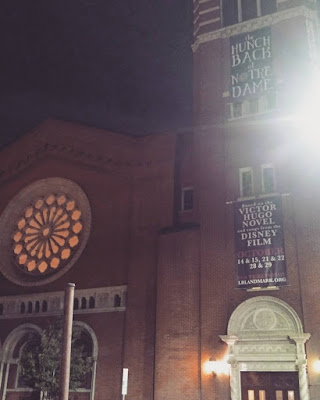
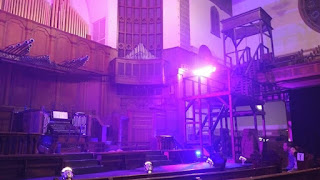
Granted, a large part of the Landmark production's uniqueness is one of fortuitous circumstance: the home base/performance venue for this new secular theater company is the First Congregational Church of Long Beach, a historical landmark completed in 1914. Needless to say the actual vintage church setting, complete with massive rose window, lends a priceless dimension of physical immersion, not to mention such a structure was literally built to amplify sounds such as Menken's choir-carried score to ample resonance. Working with a piece that is set in large part in and around the Notre Dame cathedral, one would initially be tempted to say that director Megan O'Toole and scenic designer Mark Wheeler's job is thus that much easier. However, a space that is designed for worship and not full-blown theatrical productions comes with it its own unique challenges: namely, a venue at once short on space in the traditional front "stage" area and incredibly expansive just about everywhere else. Wheeler's design indeed leans toward the minimalist side; the only huge set piece is a large wooden staircase stage left. That said, it is completely effective both in representing the Notre Dame belltower (there are no actual bells in this production, just two ropes signifying them) and being of unobtrusive, practical use for the production, for it is the bridge between the second level pews that are used for the titular character Quasimodo's (Owen Lovejoy) personal rooftop sanctuary with his imaginarily animate gargoyle friends (Matt Balin, Doug Emslie, Corey Shaw) and the more multipurpose mainstage area--in which O'Toole rather impressively makes the most of constrained space. The two big production numbers--"Topsy Turvy"/"Rhythm of the Tambourine," which serves as gypsy dancer Esmeralda (Michelle Chaho)'s grand entrance; the seductive "Tavern Song (Thai Mol Piyas)," in which Esmeralda and soldier Phoebus's (Jeff Lowe) blossoms as cathedral archdeacon Dom Claude Frollo's (Jay Dysart) lustful obsession for her grows--don't feel compromised at all, thanks to O'Toole's resourceful choreography and the skills of performers.

And given what the ultimately intimate, character-driven piece Hunchback has always been, any production ultimately rises and falls based on those performers, who not only must do justice to the complex themes rooting back to Hugo's source material but that spectacular Menken score, and the Landmark cast does the job well. Interestingly enough, Lovejoy and Chaho physically recall the animated feature's voice actors (Tom Hulce and Demi Moore, respectively), but they inject their own unique warmth and personality both together and apart; vocally, they excel in their respective stage version-exclusive numbers, Esmeralda's aforementioned "Rhythm of the Tambourine" and Quasi's 11th-hour, showstopping lament, "Made of Stone." Lowe makes Phoebus's arc from self-involved arrogance to selfless compassion convincing, and he strikes sparks with Chaho, who make the often easily overlooked love duet between Phoebus and Esmeralda, "In a Place of Miracles," an unexpected highlight of the whole production. Andrew Metzger injects real live-wire mischieviousness to Clopin, king of the gypsies, and his energy seems to feed into the rest of the cast and crew on "Topsy Turvy."

But the number everyone waits for--and, in all honesty, especially in a production staged in an actual, historic church--is Frollo's searing paean to his faith's losing battle against his base desires of the flesh, "Hellfire," and not only does Dysart make it worth the wait, so does O'Toole's chilling staging, climaxing with ensemble members slowly lowering a cross toward Frollo's head in a wash of blood red light. Moments such as these, where the themes (and are they ever more relevant than ever, in this era of blind fear and of the proverbial "other," and sexual harassment and assault by figures of authority), music, performance, staging, and (yes) setting converge to thrilling effect are why Menken and Schwartz's Hunchback is such a vital work to keep alive on stage, and why the Landmark production is a worthy entry in the piece's ongoing theatrical legacy.


Long Beach Landmark Theatre Company's production of The Hunchback of Notre Dame runs through the next two weekends, October 21-22 and October 28-29, at the First Congregational Church in Long Beach. Tickets are now available at Long Beach Landmark Theatre Company's official website.


(photo by Michael Dequina)


(photo by Michael Dequina)


Buy The Hunchback of Notre Dame American Premiere Cast album CD here.
Buy the Der Glöckner von Notre Dame 1999 German Cast album CD here.

(Special thanks to Long Beach Landmark Theatre Company)

The Movie Report wants to attend and cover all your live stage productions! Please send any and all invitations to this address. Thanks!

please buy from my eBay Wish List

please buy from my Amazon.com Wish List

Sunday, March 15, 2015

F3Stage: The Hunchback of Notre Dame opens at Paper Mill Playhouse tonight

Film Flam Flummox


After a highly popular and acclaimed run at the La Jolla Playhouse last fall, Disney's North American premiere production of the stage adaptation of composer Alan Menken and lyricist Stephen Schwartz's The Hunchback of Notre Dame makes its east coast debut at the Paper Mill Playhouse in Millburn, New Jersey tonight, Sunday, March 15. The key creatives of director Scott Schwartz and librettist Peter Parnell return from that engagement, as do principal cast members Michael Arden (Quasimodo), Patrick Page (Dom Claude Frollo), Ciara Renée (Esmeralda), Andrew Samonsky (Captain Phoebus), and Erik Liberman (Clopin)--and early word from the preview period is that while certain adjustments have been made here and there to text, it is by and large the same piece that played in San Diego. That's a good thing if you ask me, for while it certainly had room for some further fine tuning, the La Jolla production was an unforgettable emotional sweep of an experience, blending the best qualities of the underrated 1996 Disney animated film, James Lapine's 1999-2002 world premiere production in Berlin, Victor Hugo's original novel, and a number of clever and inspired original touches into an intensely intimate yet spectacular whole. My full La Jolla opening night review from last November is here.


Michael Arden as Quasimodo; Ciara Renée as Esmeralda
(photo by Jerry Dalia)

The Hunchback of Notre Dame is now running at Paper Mill Playhouse in Millburn, New Jersey through April 5, 2015.


The Movie Report wants to attend and cover all your live stage productions! Please send any and all invitations to this address. Thanks!

Wednesday, November 12, 2014

F3Stage Review: The epic emotional sweep of The Hunchback of Notre Dame

Film Flam Flummox


While certainly owing a considerable debt to the time-proven power of Victor Hugo's original literary classic, the overwhelming emotional sweep of La Jolla Playhouse's North American premiere production of The Hunchback of Notre Dame is a remarkable testament to the extraordinary talent of this specific company. From composer Alan Menken and lyricist Stephen Schwartz, who expand their criminally undervalued scores for both the 1996 Disney animated feature and James Lapine's shamefully buried 1999-2002 Berlin world premiere stage adaptation Der Glöckner von Notre Dame; to new librettist Peter Parnell and new director Scott Schwartz; to a remarkably gifted ensemble of actors, singers, and musicians, they have accomplished the daunting task of making Hugo's oft-told tale astonish and devastate as if it were brand new.

And, in many senses, this Hunchback is indeed essentially brand new, and rather startlingly so, while still recognizably inspired and derived from Disney's previous incarnations of the material. What will most strongly strike most is the appropriately, almost relentlessly downbeat and often sinister tone Parnell and director Schwartz (as the latter will henceforth be identified, so as not to be confused with the lyricist) have taken here, ironically more than several steps darker than Lapine's take, whose own (in)famously Gothic darkness was a chief reason why Disney had kept it away from the stateside stage for so long. In fact, the official credits in the show program downplay the animated feature, stating the production is "based on the Victor Hugo novel" and merely "with" songs from the Disney film--which comes immediately apparent with the opening number. While "The Bells of Notre Dame" retains Menken's familiar tune, the lush choral arrangements, and the ambitious recitative structure from the film, Parnell and lyricist Schwartz have drastically rewritten it largely as a backstory vehicle for the character of Claude Frollo (Patrick Page), who in keeping with the implicit mission statement of that official credit, is back to being the archdeacon of the Notre Dame cathedral. Thus the issue of faith, or, rather, the conflict and contradictions between the compassion inherent in one's pious duty and more personal, self-serving interests and impulses are further foregrounded here, showing how Frollo's hatred of the gypsies stems from the close relationship with his brother Jehan--and how it was destroyed when he took up with a gypsy woman and ultimately died as a result from his association with the community. Also resulting from this association is one lingering, lasting reminder that serves as an everyday test for Frollo's faith, or more accurately, his idea of faith: Jehan's horribly disfigured son Quasimodo (Michael Arden), whom he raises to serve as the bell ringer of Notre Dame, secluded from the outside world--or, in Frollo's mind, protected from the fate that befell Jehan.

Frollo's obsessively overprotective but undeniably earnest concern for Quasimodo is not only illustrative of how far removed this stage Hunchback is from the Disney film (where, for my money, the character was far and away the most despicable and memorable villain of the '90s Disney Renaissance animation period), but the difficult and complex grey shades that Parnell and director Schwartz take pains in painting. The arcs of the central characters appear fairly straightforward, all stemmed by the alluring gypsy Esmeralda's (Ciara Renée) arrival in Paris: Frollo's faith and code are further tested when she unwittingly incites in him impulses and desires that are far less than godly; more pure are the romantic feelings she stirs in Quasimodo, whose yearnings for a taste of life outside of Notre Dame's walls are made very real by the kindness she shows toward him; the arrogant captain of the cathedral guard Phoebus (Andrew Samonsky) has his self-absorption warm to selflessness when he falls for the proverbial girl from the wrong side of the tracks. But as distinct and divergent as those arcs are on the surface, they all share a strong thematic parallel: that of fiercely held individual beliefs and perceptions challenged, if not outright upended, by the harsh light of reality. While his role is beefed up from the film and now carries the bulk of the piece's comic levity, Phoebus's role is still of a secondary prominence, and not surprisingly how his originally egocentric world view is awakened to a consciousness and concern beyond himself is the most obviously and superficially handled. However, that is compensated by how deeply and powerfully the theme is explored elsewhere, particularly with the focal duo of Frollo and Quasimodo. Casting Frollo back as a member of the clergy makes for a more strikingly nuanced and therefore more realistically uncomfortable and disturbing battle between his stridently self-righteous religious convictions and his baser impulses and desires. This Frollo is no cartoon villain in any sense but a painfully flawed and misguided man who is suddenly confused, overwhelmed, and ultimately consumed by his long-repressed human instincts. As his veneer of control and decorum gradually, inevitably cracks and collapses into obsession and madness, he is not only a reprehensible figure but an equally tragic one as well.

Tragic in a different and more heartbreaking sense is Quasimodo's granted wish to experience life "out there," and with the worldly wisdom of its wonders--namely, that of love--also comes a crash course in the more complex and crueler reality of its people, who, while capable of compassion and acceptance, far from meet his long held idealized vision of them. But a most unexpected and astonishingly powerful angle on the idea comes with Esmeralda, whom Parnell and director Schwartz further deepen from the already well-rounded characterization in the animated feature and Lapine's 1999 adaptation. As in those incarnations, here Esmeralda is as smart and kind as she is feisty and sexy. But in those works, while much is said about the carefree, hedonistic gypsy lifestyle (particularly by Frollo), aside from her introductory dance performance, she's never seen indulging in such behavior, making her to a degree a woman with a heart of gold who, to paraphrase a famous quote from another famous Disney film, isn't bad, but just drawn that way. In Parnell and director Schwartz's hands, Esmeralda's upstanding code of virtue is very much intact, but she certainly isn't above shamelessly carousing and simply enjoying her life--a life built on faith, but that in the belief of an inherent, core goodness of people. As darkness consumes Frollo and circumstances for herself and her people become increasingly dire, even the most self-confident and hopeful of spirits have their breaking points, at which time there is no one and nowhere left to turn to but a different, heretofore eschewed, type of faith.

This surprising arc meets its culmination in a moment that perfectly encapsulates how Parnell and director Schwartz boldly take risks and fearlessly flout what would appear to be conventional thinking in making the material and this production their own. One of the unquestionable highlights of the Lapine production was Esmeralda's climactic 11-o'-clock ballad "Someday" (originally written as a number within the 1996 film but ultimately relegated to serve as the obligatory closing credits pop single), and how could it not be. Perfectly timed within the context of the story with appropriately elaborate staging, poignantly poetic words by lyricist Schwartz, and an epic new choral arrangement by Menken, Esmeralda leads a defiant, soul-stirring anthem of hope that only crescendoes as she literally walks toward certain doom, making for one of those singularly exhilarating and cathartic moments that can only be achieved in live theater. I was expecting and quite looking forward to experiencing such a moment in a proper English language production only to find that Parnell, Menken, and both Schwartzes have turned the song and moment completely on their ear, achieving a feeling even more raw and astonishing. With only minimal revision by lyricist Schwartz and a freshly stripped down arrangement from Menken, "Someday" takes place in the same location and at the exact same story beat, but what was once the rousing musical affirmation of Esmeralda's stalwart resolve now marks the despairing culmination of its destruction. If the famous film holdover "God Help the Outcasts" (incidentally, the tune "Someday" was originally written to possibly replace in the '96 film) marks her first, earnest, but tentative and still not completely convinced ("I don't know if You can hear me/Or if You're even there") steps toward belief in a higher power, then "Someday," sung with Phoebus after she suffers one especially cruel and dehumanizing indignity (new to this incarnation) at Frollo's hands, musically completes Esmeralda's discovery and embrace of God--but in a strikingly starker context than had ever been depicted before. Instead of being a prayer of increasingly joyous affirmation, it is now one born out of last resort desperation and defeat, making for a song and scene that is at once incredibly devastating yet incredibly beautiful.

That description applies to the whole of director Schwartz's production and his novel directorial concept. The prevailing Disney live theater "house style," if you will, has long been one of two equally weighted minds: (1) to hew as closely as possible to the source film, while at the same time (2) piling on the razzle dazzle showmanship that one equates with the Mouse House. Ironically, though, their far and away most all-around successful adaptation, Julie Taymor's handcraft-heavy take on The Lion King, is also one of their more avant garde, and director Schwartz's vision leans far more toward that more abstract--and more overtly theatrical--mind than Lapine's Berlin treatment, whose elaborate set of moving cubes and extensive use of image projections was indeed imaginative (and, in terms of the latter touch, revolutionary for the turn of the millennium era) but certainly as a means to an elaborately spectacular end. As a reflection of the 15th century era in which Hugo's story is set, director Schwartz frames the story kind of like a passion play, with a do-it-yourself "let's put on a show" framework where the seams of a performance proudly and creatively show. If Parnell's addition of a lot of Hugo-derived spoken narration delivered by ensemble and principal player alike (one of the less effective new wrinkles to the text, the role of king of the gypsies Clopin, who served as narrator in both the film and Berlin, has been significantly diminished, a shame given the game performance given in the role here by Erik Liberman) is sometimes guilty of being overly expository and hand-holding the audience where none is needed, the creators otherwise put a lot of trust in the audience to fill in the blanks. While scenic designer Alexander Dodge's primary set, consisting of wooden scaffolding, a beautiful central rose window, and an array of gargantuan bells that descend from the rafters, effectively evokes the grandeur of the cathedral's interior, the rest of the piece's settings are depicted in a more impressionistic manner, with various prop pieces such as benches and railings--and, in some inspired instances, even ensemble players--reconfiguring to form locations such as balconies and rooftops. Perhaps even more bold is the decision to avoid overly elaborate makeup and costuming, notably for Quasimodo and his gargoyle "companions." The latter are effectively reconceived as an abstractly depicted figment of Quasi's imagination, portrayed not as clearly defined characters as in previous Disney incarnations but played by various neutrally-costumed ensemble members as an anonymous but inescapable presence. Perhaps most controversially, though, is the lack of Phantom of the Opera-esque makeup and prosthetics for the lead, with Quasi's physical deformity depicted by a couple of black streaks on Arden's face.

This is why I feel the most emblematic moment in the entire piece occurs right at the close of "The Bells of Notre Dame." On the lyric "What makes a monster/And what makes a man?," Arden sings the line while walking on stage out of character and in upright posture, only to then transform into Quasimodo before the audience's very eyes, with a hump strapped onto his back as he applies the aforementioned makeup streaks on his face and affects a hunched-over gait. Such a risky decision reflects director Schwartz's overriding faith in his actors, and with such a spectacularly talented cast, that faith proves to be well-founded, and also drives home the main point that for all the mystique of its Gothic setting and its organic potential to be played on stage in the most ostentatiously over the top manner possible, the enduring appeal of Hugo's tale lies in the hearts and souls of its characters. Accordingly, the decidedly theatrical and remarkably intimate conceit of this production brings to the fore the epic emotions that drive the characters and stories, and the phenomenal central trio clearly pour their hearts and souls into bringing those interior passions and motivations out into the theatre in overwhelming fashion. The Quasi-Esme-Frollo triumvirate all depends on navigating three distinct but equally fine lines, and Arden, Renée, and Page walk their respective tightropes with deceptive ease. Arden is a soulful, consistently heartbreaking presence, and he makes seamless Quasimodo's transitions from the shy, almost stunted, demeanor he exhibits in the presence of others to the more assertive and articulate inner voice that manifests in song, and the increasingly conflicted and confused emotions that emerge with his gradual enlightenment about the outside world are piercingly poignant. Renée's portrayal lends Esmeralda nuances that run far deeper than the madonna-whore archetype the role could have easily fallen into in both text and performance, painting a believably multi-dimensional, ahead-of-her-time woman aware of and confident in the power of her feminine wiles while remaining steadfast and unyielding in her compassion and moral character. If there is a breakout performance in a production brimming with standout work, it's that of Page. While every bit as forceful and intimidating as Tony Jay's iconic voice performance in the animated feature, his work is perhaps even more frightening because of how relatable and tragically human he makes Frollo's descent into madness. Not for nothing has director Schwartz done away with any embellishment beyond a simple blood red light to the cinema--and now stage--showstopping number "Hellfire": all of the drama of Frollo being devoured by his darker, deranged desires is more than conveyed in Page's powerfully expressive face and, above all, voice.

And that points up what is ultimately the real star of The Hunchback of Notre Dame: that incredible score by Menken and lyricist Schwartz, which is made even more transcendent by the production's pièce de résistance: the onstage presence of the SACRA / PROFANA choir, making for a majestic wall of sound that matches and further amplifies the euphoric highs and devastating lows of the outsize operatic beats, both literal and emotional, of the entire piece. While it has long been my favorite of Menken's Disney film scores, the live theatrical space and performance should finally drag it from under the long, formidable shadow of his and Stephen Schwartz's more popular and celebrated works and earn its overdue recognition as a crowning achievement of both of their illustrious and legendary careers. It is a truly virtuoso piece of period- and genre-blending and -smashing musical artistry that deserves to enjoy as enduring a legacy as Hugo's original novel--or, at the very least, a long, healthy run on Broadway and on legit stages the world over in the years and decades to come.

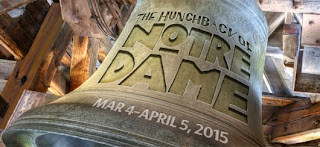
The Hunchback of Notre Dame is now playing at the La Jolla Playhouse in San Diego through Sunday, December 14. The production then moves next spring to Paper Mill Playhouse in Millburn, New Jersey, where it is scheduled to run from March 4 to April 5, 2015.


Michael Arden as Quasimodo
(photo by Kevin Berne)

(Special thanks to La Jolla Playhouse )


The Movie Report wants to attend and cover all your live stage productions! Please send any and all invitations to this address. Thanks!


Monday, November 10, 2014

Movie Music Monday: Sights from The Hunchback of Notre Dame U.S. stage premiere

Film Flam Flummox


The stage adaptation of Disney's 1996 animated feature and Victor Hugo's classic novel The Hunchback of Notre Dame finally had its long-awaited official English language debut at the La Jolla Playhouse last night, Sunday, November 9. While I am still gathering my official thoughts on the production, which features Alan Menken and Stephen Schwartz's tunes from the film, the 1999-2002 German language production Der Glöckner von Notre Dame, and some new compositions in a new book by Peter Parnell under the direction of Schwartz's son Scott (I will say this for now--it is an achievement of rich, overwhelming power on every conceivable level), here are some images I took at this exciting, exhilarating, electrifying night of live theater.


Scene at the pre-show reception


Scene at the afterparty


Librettist Peter Parnell, director Scott Schwartz,
and composer Stephen Schwartz at the afterparty

The Hunchback of Notre Dame is now playing at the La Jolla Playhouse in San Diego through Sunday, December 14.

(Special thanks to La Jolla Playhouse )


The Movie Report wants to attend and cover all your live stage productions! Please send any and all invitations to this address. Thanks!

Monday, October 20, 2014

Movie Music Monday: Changing Der Glöckner von Notre Dame back to The Hunchback of Notre Dame for the U.S. stage

Film Flam Flummox


When it was announced earlier this year that stage version of Disney's underappreciated 1996 animated classic The Hunchback of Notre Dame would be making its much-belated, hotly anticipated U.S. premiere at the La Jolla Playhouse , speculation abounded as to whether it would more closely resemble director/librettist James Lapine's acclaimed hit German language adaptation Der Glöckner von Notre Dame, which ran in Berlin from 1999 to 2002; or the more family-friendly original film. Less than a week before its first preview performance set for Sunday, October 26, La Jolla Playhouse has provided some answers with a PDF file of the final official program posted on their official website, and it appears that what director Scott Schwartz, librettist Peter Parnell, and the returning musical team of Alan Menken and Stephen Schwartz are serving American premiere audiences is a third separate incarnation almost entirely different from its predecessors--a conclusion that can be gleaned from a mere glimpse at the song number listing. Below is that listing as it appears on the program (click for a larger view), and I'll go into some bullet points on the differences and what this definitely indicates and possibly suggests about this newest incarnation of Alan Menken and Stephen Schwartz's tuneful take on Victor Hugo's classic novel. (Needless to say, spoilers abound for the Der Glöckner version and this new production, along with some pure speculation on the new version.)


  • Right off the bat, one can see that Parnell and director Schwartz have made one very significant alteration--one that Lapine reportedly wanted to make early in the development of his version but was ultimately convinced (forced?) to not go through with: removing reclusive cathedral bellringer Quasimodo's three comic relief gargoyle sidekicks. While Parnell has gone on record that gargoyles do remain in this production in some capacity, it's clear it is in a wildly diminished background one, for none are mentioned as taking part in any musical numbers either by character name or group. As such, their big number as featured in the film and Berlin incarnations, "A Guy Like You," is missing from the song list, and obviously the Berlin numbers in which they are featured that were retained for this production will have to have been reworked/rewritten.
  • The only song from the Disney film that won't be included is the aforementioned gargoyle showcase "A Guy Like You," for the late film number "The Court of Miracles," led by gypsy king Clopin, has been restored to its proper place, with its replacement in Germany, the instrumental dance number "Dance of the Gypsies," removed. A song that was originally cut from the film early in production and left out of Berlin, "In a Place of Miracles," a romantic number between Quasimodo's gypsy love Esmeralda and soldier Captain Phoebus, has been reinstated.
  • Speaking of film-cut songs that were reinstated, the incredible 11th hour number from Germany, "Someday," is indeed retained, as are these additions for the original German stage production: "Sanctuary," an expansion of Frollo's verses in "Out There"; "Rest and Relaxation," an introductory number for Phoebus; "Top of the World," a duet between Quasimodo and Esmeralda; the rousing act one closer "Esmeralda"; and Quasimodo's powerful late number "Made of Stone"...
  • ...which, in a change that makes me wonder, is now placed after "Someday" and before "Finale Ultimo." "Someday" seamlessly led into "Finale Ultimo" without an applause break in Berlin, making for relentless dramatic momentum to its powerful finish. Perhaps the removal of the gargoyles-as-characters (who were a major part of the song in Berlin) and whatever changes to the ending motivated the order swap.
  • Additions in Germany apparently jettisoned for the States: "Balancing Act," an early act 1 number that introduces the melody to the act 1 finale song "Esmeralda"; the choral-driven act 2 opener "City Under Siege", the act 2 Quasimodo/Phoebus duet "Out of Love"; and the aforementioned instrumental "Dance of the Gypsies."
  • All-new in La Jolla: "Rhythm of the Tambourine," which appears to be an extended introduction number for Esmeralda; "The Tavern Song," a number for Quasimodo's dastardly master Frollo and Esmeralda in the middle of act 1; and "Flight into Egypt," an act 2 number for Quasimodo and Esmeralda.
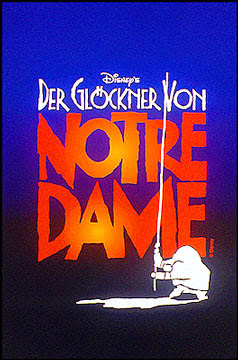
But most striking of all, which is reflected by the removal of the gargoyles, is the apparent "de-Disney-fying" of the entire piece, both in content and any materials related to this production. The company's familiar logo is nowhere to be found on the official poster (even the haunting, minimalist key art for that famously dark German production had it prominently featured), and the company's name only appears in the finest of print, as being part of a "special arrangement." But perhaps most telling of all is this official credit: "Based on the Victor Hugo novel with songs from the Disney film." Could it be that this Hunchback is a full-blown, twelve-hanky tearjerker on the level of a certain other Hugo-based stage musical, Les Misérables? I guess we'll all find out when the show runs from October 26 to December 14 at the La Jolla Playhouse . More information and ticket sales at the official website.


The Movie Report wants to attend and cover all your live stage productions! Please send any and all invitations to this address. Thanks!

Friday, September 5, 2014

F3PR: La Jolla Playhouse announces cast for U.S. premiere of The Hunchback of Notre Dame

Film Flam Flummox

PRESS RELEASE


LA JOLLA PLAYHOUSE ANNOUNCES
CAST FOR U.S. PREMIERE OF
THE HUNCHBACK OF NOTRE DAME,
MUSIC BY ALAN MENKEN, LYRICS BY STEPHEN SCHWARTZ,
BOOK BY PETER PARNELL, DIRECTED BY SCOTT SCHWARTZ

Michael Arden, Patrick Page,
Andrew Samonsky and Erik Liberman
Make Triumphant Return to San Diego;
Rising Star Ciara Renée
Rounds Out Top-Notch Cast of
Broadway Veterans and Local Talent

La Jolla, CA — La Jolla Playhouse announces the cast for its upcoming U.S. premiere musical, The Hunchback of Notre Dame, featuring a score by the multiple Academy®, Grammy® and Tony® Award-winning team of composer Alan Menken (Newsies, Little Shop of Horrors) and lyricist Stephen Schwartz (Wicked, Pippin), book by Peter Parnell (The West Wing, On a Clear Day You Can See Forever) and direction by Scott Schwartz (Playhouse’s Jane Eyre, Broadway’s Golda’s Balcony). Produced in association with Paper Mill Playhouse, by special arrangement with Disney Theatrical Productions, The Hunchback of Notre Dame will run October 26 – December 7, 2014 in the Playhouse’s Mandell Weiss Theatre.

"We are excited to welcome this knock-out company of local and national talent to the Playhouse – many of whom have delighted San Diego audiences for years,” said Playhouse Artistic Director Christopher Ashley. “They will give full-throated life to Victor Hugo’s classic story of love, obsession and heroism as reimagined by this truly powerhouse creative team."

The cast features Michael Arden (Broadway’s The Times They Are A-Changin’, Big River) as “Quasimodo,” Patrick Page (Broadway’s Spider-Man: Turn Off the Dark, The Lion King, How the Grinch Stole Christmas!) as “Frollo,” Ciara Renëe (Broadway’s Pippin, Big Fish) as “Esmeralda,” Andrew Samonsky (Playhouse’s Little Miss Sunshine, Broadway’s The Mystery of Edwin Drood) as “Phoebus” and Erik Liberman (Broadway’s Lovemusik) as “Clopin.”

Five San Diego-based actors will be part of the ensemble: Lucas Coleman, Mary Joe Duggan and Anise Ritchie, along with UC San Diego M.F.A. students Brian Smolin and William Thomas Hodgson. Additional ensemble members include Julian Decker, Ian Patrick Gibb, Beth Kirkpatrick, Samantha Massell, Neal Mayer, Nora Menken, William Michals, Vincent Rodriguez and Richard Ruiz. As previously announced, the acclaimed local choir SACRA/PROFANA will serve as the show’s on-stage chorus.

The creative team also includes Chase Brock (Spider-Man: Turn Off the Dark), choreographer; Michael Kosarin (Newsies), music supervisor and arranger; Brent-Alan Huffman, music director; Michael Starobin (Tangled), orchestrator; Alexander Dodge (Playhouse’s Limelight: The Story of Charlie Chaplin), scenic designer; Alejo Vietti (Beautiful), costume designer; Howell Binkley (Memphis, Jersey Boys), lighting designer; Gareth Owen (A Little Night Music), sound designer and M. William Shiner, production stage manager.

Based on the Victor Hugo novel and featuring the Oscar®-nominated score from the 1996 Disney animated classic, The Hunchback of Notre Dame is the only stage collaboration from two masters of the American musical theatre, composer Alan Menken and lyricist Stephen Schwartz. Celebrated for such beloved and award-winning works as Menken’s Newsies, Beauty and the Beast and Aladdin and Schwartz’s Godspell, Pippin and Wicked, their artistry reaches its zenith in The Hunchback of Notre Dame. Featuring a lush, emotionally rich score, this brand new production from acclaimed director Scott Schwartz highlights the music's orchestral power and choral beauty in an intimate retelling of the famous love story. Librettist Peter Parnell crafts a bold, highly-theatrical take on the moving tale of the scorned bell-ringer Quasimodo, the beautiful gypsy Esmeralda and the dashing Captain Phoebus in 15th century Paris.

Casting for the Paper Mill Playhouse engagement of The Hunchback of Notre Dame will be announced at a later date.

Tickets for The Hunchback of Notre Dame are currently available at LaJollaPlayhouse.org or by calling (858) 550-1010.


The Movie Report wants to attend and cover all your live stage productions! Please send any and all invitations to this address. Thanks!
Monday, February 24, 2014

Movie Music Monday: Looking ahead to The Hunchback of Notre Dame, looking back to Der Glöckner von Notre Dame

Film Flam Flummox


It's only taken 15 years since it was first officially brought to a live theatre--and 18 since the film hit cinemas--but Disney's most undervalued modern animated masterworks, 1996's The Hunchback of Notre Dame is finally making its belated bow on an American stage later this year, beginning Sunday, October 26, at the La Jolla Playhouse near San Diego, California. Even the most devoted of cinephiles may be baffled at my opening statement, for aside from the most ardent of Hunchback devotees, not even too many Disney fans are aware of Der Glöckner von Notre Dame, the highly acclaimed and very successful live adaptation that was produced in Germany from 1999 to 2002. The Mouse clearly had high hopes for Hunchback to become its third Broadway production following the blockbuster stage translations of Beauty and the Beast and The Lion King, for a theatre in Berlin was built expressly to house the production, whose book and direction was by multi-Tony-winner James Lapine, best known for his collaborations with Stephen Sondheim.

But for all the outward votes of confidence, the '99 stage incarnation of Hunchback seemed to be suffering from oddly dragging feet by the studio, most obviously in premiering way out of town--and thus mostly off the American entertainment radar--across the Atlantic. A few reasons were speculated as to exactly why. While the film was a financial success, it was not nearly as huge a one, in terms of both box office and pop culture zeitgeist, as its immediate predecessors The Lion King and even Pocahontas. But perhaps the biggest reason was, ironically, that for which the original film mostly earned its plaudits. The wide critical acclaim for Alan Menken and Stephen Schwartz's ultimately Oscar-nominated score and the film as a whole zeroed in on its gritty, Gothic qualities that threatened to earn the film a then-animation-kiss-of-death PG rating (which the existing film would surely receive today). Lapine, most famous for his and Sondheim's dark, revisionist fairy tale mash-up Into the Woods (ironically enough, set for a much-belated film adaptation to be released at the end of the year from Disney), amped up those qualities even more so in his adaptation, with our outcast bellringer hero Quasimodo more of a stunted, awkward type; the comic relief trio of gargoyles more explicitly figments of his lonely imagination; and, most infamously, reworked the film's sanitized (though still poignant) ending to a much grimmer one more in line with the original Victor Hugo novel. But like many tearjerking stage sensations before it, such as another little Hugo-based show by the name of Les Misérables, this didn't matter to audiences, whose world-travelling word of mouth drove the show to a three-year run, an unprecedented duration for a live production in Germany. Despite all this, no concrete plans were ever set into motion for the show to make its way back home to the States, and as the years passed, with Disney giving the stage adaptation treatment for Tarzan, The Little Mermaid, Mary Poppins, Aladdin, and even the notorious live action flop Newsies, it seemed like those hoping for a proper English language Hunchback production would have to content themselves with the excellent German cast recording and a number of complete video recordings of varying quality, which only confirmed how spectacular it was in terms of production value and emotional impact, not to mention the Broadway-ready grandeur and power of that Menken/Schwartz score.

The Hunchback that will be premiering in La Jolla will be a different one than that which wowed Berlin audiences. Lapine is gone both as director and librettist, with Peter Parnell writing the new book and helming duties taken over by Scott Schwartz, son of Stephen; thus, Lapine's ambitious, and technically demanding, staging featuring hydraulic cubes and image projections, is also gone. Der Glöckner already featured some new Menken/Schwartz compositions in addition to most of the film's score (the late number "Court of Miracles" was replaced for the stage), but word is that the pair have wrote even more new songs for the American premiere, so what numbers from both the film and Der Glöckner is very much in question. So bearing in mind that while Hunchback will finally see its day on the U.S. stage, and the Der Glöckner incarnation is more or less completely dead, below is a reel of mostly unsubtitled musical numbers from that terrific production, including the complete ending--whose operatic emotional wallop one hopes the new production is able to match with its finale.

The Hunchback of Notre Dame is scheduled to make its U.S. premiere engagement at the La Jolla Playhouse October 26 through December 7. For more information, visit the website.


The Movie Report wants to attend and cover all your live stage productions! Please send any and all invitations to this address. Thanks!

Wednesday, June 13, 2012

F3PR: Little Shop of Horrors The Director's Cut on Blu-ray October 9

Film Flam Flummox

PRESS RELEASE

LITTLE SHOP OF HORRORS
THE DIRECTOR’S CUT

BLOSSOMS ON BLU-RAY™ OCTOBER 9
FOR THE FIRST TIME ON BLU-RAY IN 2012

Includes Highly Anticipated
20-Minute Alternate Ending,
Now Restored and in Color from Warner Home Video,
with Digitally Re-mastered Picture and 5.1 Sound

Little Shop of Horrors, nominated for two Academy Awards® in 1986, including Best Music, Original Song and Best Effects, Visual Effects, debuts on Blu-ray Disc™ October 9, 2012 from Warner Home Video. The Blu-ray debut of the film, directed by the inimitable Frank Oz (Dirty Rotten Scoundrels, The Dark Crystal, The Muppets Take Manhattan), includes two hi-def versions of the cult classic: the one shown in theaters and The Director’s Cut, featuring a newly restored 20-minute ending from the director’s first cut, now in color, that fans have been waiting to see.

The footage of the original ending was previously available only in black & white in the extra content of a limited number of copies of a DVD edition released in 1998. Now, with the help of production notes from Frank Oz and others on the film’s creative team, WHV has meticulously restored and digitally remastered the ending, in full color, with the elaborate special effects in tact. Sound has also been rebuilt and mixed in Dolby 5.1. The theatrical version has also been re-mastered.

Little Shop of Horrors The Director’s Cut is loaded with extras, including commentary by director Frank Oz (on the theatrical version), introduction by Oz with Richard Conway, outtakes, deleted scenes, and a behind-the-scenes documentary – all presented in a commemorative Blu-ray Book boasting 40 pages of behind-the-scenes insight, including film trivia, actor and director bios and more. Little Shop of Horrors The Director’s Cut has a suggested retail price of $34.99. Orders are due September 4, 2012.

On July 26, 2012, the Academy of Science Fiction, Fantasy and Horror Films will present the Life Career Award to Oz at the 38th Annual Saturn Awards, the highest honor for genre filmmaking. The special award recognizes Oz for his work as a director, as well as the indelible contributions he has made as performer of such unforgettable characters as Yoda and Miss Piggy.

Little Shop of Horrors stars Rick Moranis (Little Giants, The Flintstones, Parenthood, Honey, I Shrunk the Kids), Ellen Greene (The Cooler, TV series The Young and the Restless, Heroes, Pushing Daisies), Vincent Gardenia (Moonstruck), with a special appearance by Steve Martin (It’s Complicated, The Pink Panther, Cheaper by the Dozen), and more.

SYNOPSIS

In this cult classic, a nerdish florist finds his chance for success and romance with the help of a giant man-eating plant who demands to be fed.

SPECIAL FEATURES:

  • Theatrical version of the film with optional commentary
  • The Director’s Cut featuring the newly restored 20-minute alternate ending
  • Digitally re-mastered picture and 5.1 sound on both versions
  • "Frank Oz and Little Shop of Horrors The Director's Cut," an introduction by Frank Oz with Richard Conway
  • "A Story of Little Shop of Horrors" (behind-the-scenes documentary)
  • Outtakes and deleted scenes with optional commentary
  • Two theatrical trailers


My Amazon.com Wish List

Instagram: @twotrey23

Twitter: @twotrey23