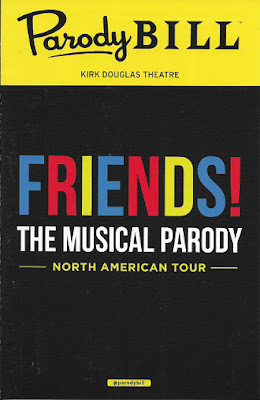
As someone who not only regularly watched Friends during its historic original ten-season run that began 25 (!) years ago this coming fall but still watches the syndicated reruns on a near-nightly basis as background late night comfort food, I'm not exactly the best person to most accurately assess the stand-alone, self-contained merits of Friends! The Musical Parody, whose North America tour production is currently stationed at Center Theatre Group's Kirk Douglas Theatre in Culver City. However, that über-familiarity with the influential, iconic NBC sitcom makes me all the more appreciative, impressed, if not downright stunned at just how much material writers/lyricists Bob and Tobly McSmith and director Tim Drucker pack and condense into this a breathless 90 minutes over two acts. The feeling I had while in the theatre must be akin to what devotees of The Brady Bunch while watching The Brady Bunch Movie and A Very Brady Sequel in the cinema in the '90s, with a stream of nostalgic references to individual episodes as constant and unwavering as the gags.
Luckily for those in the audience, Friends fan and non-fan alike, just as constant and unwavering is the boundless spark and enthusiasm of the terrific ensemble. While stellar chemistry between its core sextet of actors appropriately mirrors that of their forebears on the tube, also like the original six, each individually brings their own distinct energy and approach to their respective characters, who do register as appealing comic creations regardless of previous familiarity. As one would expect with a parody production, a number of the cast members go for more spot-on impressions, namely Madison Fuller's accurate capturing of the daffy charm of Lisa Kudrow's Phoebe Buffay; Domenic Servidio's recreation of lovable lunk-headed lothario Joey Tribbiani, originally essayed by Matt LeBlanc; and Sami Griffith's downright eerie channelling of Jennifer Aniston's inflections, mannerisms, and facial expressions as spoiled little runaway bride Rachel Green. The others--Maggie McMeans as Courteney Cox's neurotic neat freak Monica Geller, Aaron C. Rutherford as Matthew Perry's ever-wisecracking Chandler Bing; Tyler Fromson as David Schwimmer's geeky, oft-married Ross Geller--go for less literal, more spiritual impressions. Adding additional spice are Jenna Cormey and Nick Palazzo, who turn up at various supporting characters/guest stars. The contrast in approaches, much like that in the personalities of the characters, help keep the silly proceedings from being one-note.
Indeed, silly it all is, and any newcomers to all things Friends will likely be hard pressed to find a completely coherent narrative through-line, especially given that the show compresses an entire decade's worth of "Must See TV" into 90 minutes, with the McSmiths and Drucker wisely using the intermission to skip over some years. But even if all of the events and that steady stream of in-jokes and episode references fly clear over the heads of non-fans, everyone would get the appeal of the completely original songs composed by Asaaf Gleizner, which runs the gamut of sounds from traditional showtunes to pop to even hip-hop. That last note is another example of how the experience is further enhanced by viewership of the original show, referencing Sir Mix-A-Lot's "Baby Got Back," which was central to one late season episode; and the McSmiths cleverly build a few tunes out of characters' signature catchphrases and notable dialogue, even having cheeky fun with how, due to copyright restrictions, this Phoebe cannot sing her infamous ditty "Smelly Cat" (which is an even deeper-reaching reference for fans since she, on the original show, was ultimately barred from performing it). Billy Griffin's choreography matches the high spirits of the production and makes good use of the entire ensemble throughout. Even if the dancing isn't the most complicated nor intricate, nor are the cast members great dancers, the sheer exuberance sells the movements.
And that exuberance, inviting and infectious, infuses and sells the entire production. Friends! The Musical Parody, with its functional but still evocative scenic design by Josh Iacovelli (a dual-sided sofa that is rotated to serve as Monica's couch and that at coffeehouse hangout Central Perk is an example of that perfect balance of imagination and practicality), and spot-on but equally no-frills costuming by David Rigler, may somewhat remind of a live sketch/improv show on the physical production level. But like such a show, its ultimate success is really dependent on the timing and talents of the troupe, and they most definitely bring the fun and funny.
Aaron C. Rutherford as Chandler Bing, Sami Griffith as Rachel Green,
Madison Fuller as Phoebe Buffay, Maggie McMeans as Monica Geller,
Domenic Servidio as Joey Tribbiani, Tyler Fromson as Ross Geller
(photo courtesy Right Angle Entertainment)
Classical-style opera is generally associated with stories and, more often than not, works from many years ago. But the artform can also be used, and rather effectively at that, to tell contemporary stories, particularly those that navigate the often roller coaster gamut of emotion within human existence. Such is the powerful case (no pun intended) with composer Anthony Davis and librettist Richard Wesley's take on the true tale of tragic injustice that befell the then-so-named The Central Park Five, currently in its world premiere production mounted by the Long Beach Opera.
Three decades may have passed since the five of the title--aged only 14 to 16, four African-American, one Latino--were wrongly convicted of the 1989 beating and rape of a white female jogger in New York's Central Park, but awareness of the story is probably even more widespread today than it was back then, thanks to Ava DuVernay's celebrated miniseries When They See Us, which began streaming on Netflix literally (and completely coincidentally) a couple of weeks ago. But beyond also being the subject of a near-simultaneously released, higher profile project, this shameful blight in American history could sadly not more be relevant to and reflective of the social and political climate of today. Despite a glaring lack of concrete evidence, law enforcement was quick to criminalize young Antron McCray (Derrell Acon), Yusef Salaam (Cedric Berry), Raymond Santana (Orson Van Gay), Kevin Richardson (Bernard Holcomb), and Korey Wise (Nathan Granner), and forced them into false confessions without adult, let alone professional legal, counsel. A voracious news media was all too quick and eager to go along with the narrative, with prominent figures amplifying the sentiment to even more sensationalistic and alarmist levels, including a certain brash real estate developer (played by Thomas Segen) still many years removed from his eventual perch in the highest political office of the country but already exhibiting and expressing his now-even-more-familiar blowhard attitudes and viewpoints on particular demographic groups.
The one glaring misstep in Wesley's libretto is that depiction of now-45, not in terms of accuracy but in falling into the trap of going for the cheap and easy joke; the second act opens with no less than him on a phone call while sitting on a golden toilet. But as the term "operatic" is often applied, trafficking in broad strokes to convey a greater truth is a convention in the genre, and having an exaggerated, if cartoonishly so, 45 as well as an amorphous character billed as "The Masque" (Zeffin Quinn Hollis) representing, at various points, either the oppressively long arm of the law, public sentiment, or White Paranoia itself effectively depict the monolithic system that the five and their truth was (and, ultimate, far too belated exoneration aside, still are) up against. Similarly, with the late exception of Wise, the one of the group who was sent to an adult prison, the five themselves are treated more as a collective than individuals, but so speaks to the larger point of how young men of color, particularly African-Americans, regardless of individual personality and circumstance, are viewed in the same ever-suspicious lens from all angles.
Director Andreas Mitisek's physical production further reinforces this notion in at once spartan and overwhelming fashion. Doors and screens are often the only objects on stage with the actors, but they more than do their jobs practically and metaphorically, representing the various spaces, rooms, and cells and offering surfaces on which to project many archival video clips, images, and newspaper headlines, smothering the protagonists in their humiliating negativity and prejudice. Cannily, Davis's score, which pulls as much from jazz influences as it does classical ones, also reflects the persistent tension between black and white, truth and untruth in his copious use of dissonance between the vocal lines and those played by the orchestra. With the uniformly strong-voiced cast and the gifted musicians in the pit landing all the notes beautifully and memorably, the effect is appropriately jarring and discomfiting in the best way, That applies to The Central Park Five as a whole, an overall beautifully composed and produced work that dares to powerfully remind of an uncomfortable case in recent history and underscore how the circumstances and atmosphere that led to such a tragic injustice are just as much, if not even more, overtly present in the here and now.