



reviewsextraslinksguestbooksitemap
TheMovieReport.com
navigation buttons
Showing posts with label opera. Show all posts

Friday, September 24, 2021

F3Stage Review: The fiery passions & voices of LA Opera's Il Trovatore triumph over a muted design

Film Flam Flummox

Il Trovatore

Giuseppe Verdi's Il Trovatore is a tale of fiery, often conflicting, passions--that of an intense romance; that of an unrequited love; that for revenge--so it makes sense that actual flames notably figure in the physical design of LA Opera's big return to the live stage of the Dorothy Chandler Pavilion. But what really ignites the production is the figurative fireworks set off by voices and performances by the leads, who ultimately shine far brighter than the imposing physical production.

Louis Désiré's design for director Francisco Negín's production is hard to ignore from the initial curtain raise, but not for the extravagant opulence one typically associates with opera; rather, quite the opposite. Ironically, such a tale of emotions run amok--the love and devotion between the troubadour of the title, Manrico (Limmie Pulliam in performances through October 3; Gregory Kunde from October 6 through 10) and Leonora (Guanqun Yu); the Count DiLuna's (Vladimir Stoyanov)'s pathological pining for Leonora; Manrico's mother Azucena's (Raehann Bryce-Davis) quest to avenge her mother's death--plays out in a stark, stone cold grey box with a heavily raked floor. Perhaps reflecting the heavy burdens all the principals carry, there's even a vertical pillar upstage that's occasionally pushed by the leads across the stage length while in song. Undoubtedly, the stark set makes for some occasionally striking stage pictures when working in tandem with other elements (case in point, pictured below, the cross that forms during a scene taking place in a convent) and Bruno Poet's lighting design, and the overall dearth of color makes the pyrotechnic elements all the more punctuating, especially the memorable finale. But with Désiré's costumes similarly muted for the leads and the chorus members, the latter not only additionally done up in anonymous white face makeup, but also literally hiding in the walls much of the time, visually the show becomes a bit monotonous.

Thankfully, though, Verdi's music--and, thus, the emotion of the piece--under the ever-reliable baton of James Conlon is thrilling. Most of the lead quartet is nothing short of exquisite. Yu's Leonora has a luminous soprano to match her graceful stage presence, and her chemistry with the commanding and charismatic Pulliam makes the central romance consistently resonate. Perhaps the real star here is Bryce-Davis, who is simultaneously, appropriately menacing and heartbreaking as Azucena; her ever-simming anger, and the sadness behind it, is mesmerizing as it ultimately consumes all in her path. Stoyanov does not make quite the lasting impression in the less showy role of Count DiLuna, but he is a more than adequate foil to his co-stars. And despites its everlasting ubiquity across all media, the most famous passage of the opera, the "Anvil Chorus," retains its melodic, infectious punch in a live music hall.

And that, right there, underscores how valuable it is to have LA Opera back in season, and even with this Il Trovatore making some unconventional, maybe even questionable, choices, what does work exemplifies how nothing quite matches the creativity and excitement of the live performing arts.


Limmie Pulliam as Manrico, Guanqun Yu as Leonora,
Vladimir Stoyanov as Count di Luna, Morris Robinson as Ferrando
(photo by Cory Weaver)

LA Opera's production of Il Trovatore will have four more performances, on Saturday, September 25; Sunday, October 3; Wednesday, October 6; and Sunday, October 10, at the Dorothy Chandler Pavilion in The Music Center in Downtown Los Angeles. The October 3 and 6 performances will also be available for livestream at the LA Opera On Now digital platform.

(Special thanks to LA Opera)


The Movie Report wants to attend all your live stage productions! Please send any and all invitations to this address. Thanks!

Follow me on Instagram - @twotrey23 Follow me on Twitter - @twotrey23 Subscribe to TheMovieReport.com YouTube Channel

Thursday, September 26, 2019

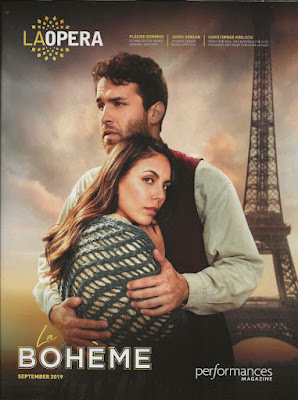
F3Stage Review: LA Opera stages a darkly alluring & affecting La Bohème

Film Flam Flummox


Giacomo Puccini's La Bohème is one of the most widely known and, thus, widely produced operas around the world, and so it would be easy, and quite understandable, for a company to play it safe and traditional with its staging. But after mounting the same Herbert Ross-directed production no less than seven times (most recently in 2016) over the last 25 years, LA Opera revives Puccini's tale of bohemian bonhomie and tragic romance in a dark, striking, and different staging that director Barrie Kosky premiered in Berlin earlier this year.

The particulars of the plot remain as familiar as they have been to opera aficionados--and, for that matter, fans of Jonathan Larson's ever-popular La Bohème-inspired '90s musical Rent. In 1830s Paris, poet Rodolfo (Saimir Pirgu), "painter" (more on the quotes later) Marcello (Kihun Yoon), philosopher Colline (Nicholas Brownlee), and musician Schaunard (Michael J. Hawk) are starving artist roommates struggling to pay rent to landlord Benoit (who, in Kosky's big deviation, does not appear at all here, with the four instead play-acting his part); Marcello pines over lost love Musetta (Erica Petrocelli), has moved on to another; Rodolfo meets and falls for neighbor Mimi (Marina Costa-Jackson), but looming over their romance is the spectre of disease. Coincidental or not, one cannot help but see some echoes of Larson's work here, from the more youthful than the norm cast, to the Mimi here sharing Mimi Marquez's bright, forceful joie de vivre that only the absolute final stages of terminal illness can dampen, to making Marcello only a metaphoric "painter" and more literally working in film, namely early forms of photography.

But, make no mistake, this La Bohème is distinctly Kosky's own. Much of his concept springs from that shift in Marcello's art, with blacks, whites, and greys dominating the palette he crafts with scenic designer Rufus Didwiszus and lighting director Alessandro Carletti. While this choice falls a bit short in act three, where a static black and white, period photography-tech accurate street scene drop feels a bit too minimalist, it makes for an appropriately ominous atmosphere hanging over the entire proceedings and lends a darkly alluring sense of decadence and indulgence to the act 2 Cafe Momus. It is here that Kosky and his designers appropriately go the most grandiose, with the principal cast and a horde of chorus members young and old in Victoria Behr's striking costumes create a vibrant, bustling, constantly shifting scene on a revolve stage. The exuberance is in effective, sharp relief to more somber turn post-intermission and, of course, in the fourth and final act, where the tragedy is augmented by some truly stunning stage pictures, particularly the final images.

But images would only half serve Puccini's intended effect, and thankfully Kosky's cast is up to the task in lending the characters life. All of the principals are in strong, fine voice, but appropriately the pair of romantic leads make the strongest impression, with Pirgu and Costa-Jackson fittingly striking an immediate spark right from when Rodolfo lights Mimi's candle. Costa-Jackson especially resonates in both literal and character voice, and once Mimi takes her final breath, Kosky's untraditional approach lends the loss and the overall production a lingering and haunting sadness and shiver.


Saimir Pirgu as Rodolfo, Marina Costa-Jackson as Mimi
(photo by Cory Weaver)

LA Opera's production of La Bohème will have two more performances, on Wednesday, October 2, and Sunday, October 6, at the Dorothy Chandler Pavilion in The Music Center in Downtown Los Angeles.

(Special thanks to LA Opera)

The Movie Report wants to attend all your live stage productions! Please send any and all invitations to this address. Thanks!

Follow me on Instagram - @twotrey23 Follow me on Twitter - @twotrey23 Subscribe to TheMovieReport.com YouTube Channel

Monday, June 17, 2019

F3Stage Review: The Central Park Five opera powerfully retells the true tragedy of injustice

Film Flam Flummox


Classical-style opera is generally associated with stories and, more often than not, works from many years ago. But the artform can also be used, and rather effectively at that, to tell contemporary stories, particularly those that navigate the often roller coaster gamut of emotion within human existence.  Such is the powerful case (no pun intended) with composer Anthony Davis and librettist Richard Wesley's take on the true tale of tragic injustice that befell the then-so-named The Central Park Five, currently in its world premiere production mounted by the Long Beach Opera.

Three decades may have passed since the five of the title--aged only 14 to 16, four African-American, one Latino--were wrongly convicted of the 1989 beating and rape of a white female jogger in New York's Central Park, but awareness of the story is probably even more widespread today than it was back then, thanks to Ava DuVernay's celebrated miniseries When They See Us, which began streaming on Netflix literally (and completely coincidentally) a couple of weeks ago.  But beyond also being the subject of a near-simultaneously released, higher profile project, this shameful blight in American history could sadly not more  be relevant to and reflective of the social and political climate of today.  Despite a glaring lack of concrete evidence, law enforcement was quick to criminalize young Antron McCray (Derrell Acon), Yusef Salaam (Cedric Berry), Raymond Santana (Orson Van Gay), Kevin Richardson (Bernard Holcomb), and Korey Wise (Nathan Granner), and forced them into false confessions without adult, let alone professional legal, counsel.  A voracious news media was all too quick and eager to go along with the narrative, with prominent figures amplifying the sentiment to even more sensationalistic and alarmist levels, including a certain brash real estate developer (played by Thomas Segen) still many years removed from his eventual perch in the highest political office of the country but already exhibiting and expressing his now-even-more-familiar blowhard attitudes and viewpoints on particular demographic groups.

The one glaring misstep in Wesley's libretto is that depiction of now-45, not in terms of accuracy but in falling into the trap of going for the cheap and easy joke; the second act opens with no less than him on a phone call while sitting on a golden toilet.  But as the term "operatic" is often applied, trafficking in broad strokes to convey a greater truth is a convention in the genre, and having an exaggerated, if cartoonishly so, 45 as well as an amorphous character billed as "The Masque" (Zeffin Quinn Hollis) representing, at various points, either the oppressively long arm of the law, public sentiment, or White Paranoia itself effectively depict the monolithic system that the five and their truth was (and, ultimate, far too belated exoneration aside, still are) up against.  Similarly, with the late exception of Wise, the one of the group who was sent to an adult prison, the five themselves are treated more as a collective than individuals, but so speaks to the larger point of how young men of color, particularly African-Americans, regardless of individual personality and circumstance, are viewed in the same ever-suspicious lens from all angles.

Director Andreas Mitisek's physical production further reinforces this notion in at once spartan and overwhelming fashion.  Doors and screens are often the only objects on stage with the actors, but they more than do their jobs practically and metaphorically, representing the various spaces, rooms, and cells and offering surfaces on which to project many archival video clips, images, and newspaper headlines, smothering the protagonists in their humiliating negativity and prejudice.  Cannily, Davis's score, which pulls as much from jazz influences as it does classical ones, also reflects the persistent tension between black and white, truth and untruth in his copious use of dissonance between the vocal lines and those played by the orchestra.  With the uniformly strong-voiced cast and the gifted musicians in the pit landing all the notes beautifully and memorably, the effect is appropriately jarring and discomfiting in the best way,  That applies to  The Central Park Five  as a whole, an overall beautifully composed and produced work that dares to powerfully remind of an uncomfortable case in recent history and underscore how the circumstances and atmosphere that led to such a tragic injustice are just as much, if not even more, overtly present in the here and now.


The Central Park Five composer Anthony Davis
and director Andreas Mitisek during the pre-show talk
(photo by Michael Dequina)

The Long Beach Opera's world premiere production of Anthony Davis's The Central Park Five will have two more performances, on Saturday, June 22 and Sunday, June 23, at the Warner Grand Theatre in San Pedro.

(Special thanks to Long Beach Opera and Davidson & Choy Publicity)


The Movie Report wants to attend and cover all your live stage productions! Please send any and all invitations to this address. Thanks!
Instagram: @twotrey23

Twitter: @twotrey23